Conclusion
What the course claimed
Introduction.md set out two ways of teaching scientific writing and chose one. A prescriptive approach specifies a template and treats writing as compliance with it; a rhetorical, or functional, approach treats each component of an article as serving a communicative function within an argument, and treats structure and style as choices made in service of that function. The course adopted the second, and justified the choice on three grounds. It is worth returning to them, since a course that argued for a claim at its outset owes an account of whether the claim held.
The transfer argument was that section names and formatting requirements vary across venues and subfields while the functions those sections serve do not. Part V is where this was tested against the least stable material in the course: page limits, anonymity rules, review models, checklist items, and disclosure policies, all of which have changed within recent memory and will change again. The functional reading survived each of them — a page limit is a constraint on where argumentative space goes, an anonymity rule is a constraint on how self-reference is phrased, a checklist is the Method’s reconstructive function made auditable. The specific numbers stated in V.C will date; the readings will not.
The fit argument was that different contributions require different distributions of emphasis, which a fixed template cannot represent. Section I.B’s three structural variants carried this claim through every subsequent section — the recurring question of how a piece of advice differs for a system/method, an empirical/analysis, and a resource/dataset paper produced genuinely different answers often enough to justify the apparatus, and occasionally produced the honest answer that little varies, which a prescriptive account has no way to say.
The diagnostic argument was that “which function is not being served” is more useful than “which rule was broken,” because writing can be rule-compliant and still fail. This was the claim that did the most work. Almost every failure the course named was a functional failure with a rule-compliant surface: the grammatical opening sentence that establishes territory needing no establishing, the correctly formatted citation supporting a stronger claim than its source makes, the accurate caption that labels a figure instead of stating what it shows, the well-hedged sentence that hedges a directly measured result.
The diagnostic, in its final form
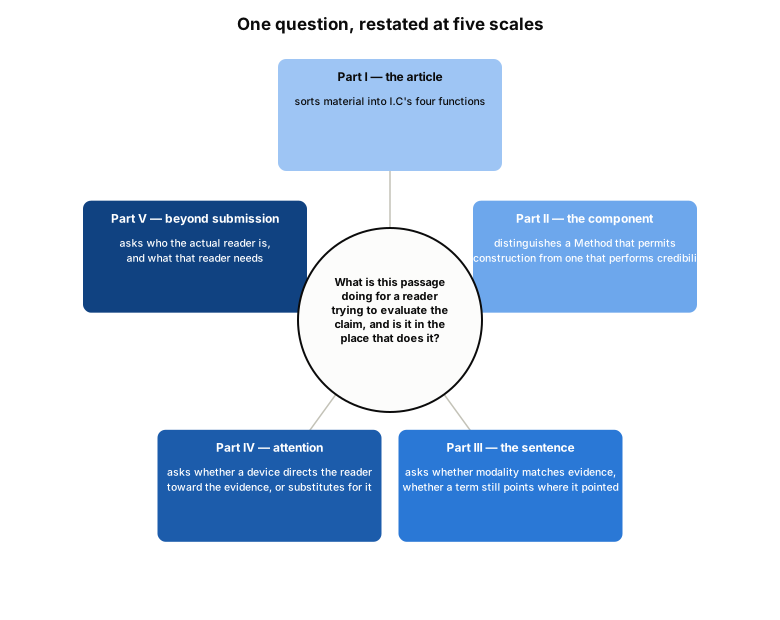
One question recurred at every level of granularity, and it can now be stated once at full generality: what is this passage doing for a reader trying to evaluate the claim, and is it in the place that does it? At the level of the article, the question sorts material into I.C’s four functions. At the level of the component, it distinguishes a Method that permits reconstruction from one that performs credibility. At the level of the sentence, it asks whether modality matches evidence, whether a term still points where it pointed, whether a connective names a relation that holds. At the level of attention, it asks whether a device directs a reader toward what the evidence supports or substitutes for it. And beyond submission, it asks who the actual reader of a response, a statement, or a disclosure is, and what that reader needs.
The question is not a formula, and it does not resolve every case. Its value is that it is always askable, and that it fails informatively: a passage for which the question has no good answer is a passage that should probably not exist, which is a conclusion no style rule ever licenses.
What the course does not cover
The scope stated at the outset was narrow, and holding to it left several adjacent competences untreated. The course does not address the conduct of research — the design of experiments, the choice of what to study — except where writing decisions constrain it, as in the observation that a reproducibility checklist read before the experiments changes the experiments. It does not teach reviewing, which is a distinct skill that this course touches only from the reviewed side. It does not cover the genres neighbouring the article: grant proposals, theses, survey articles, position papers, and technical reports each have different readers and would need their own functional analysis. It says nothing about oral presentation or poster design, which share the article’s argument and almost none of its constraints. And it assumes writing in English at anglophone-dominated venues, which is a real limitation rather than a neutral default, since it silently excludes both the additional labour that non-native writers carry and the norms of publication traditions organized differently.
Beyond NLP
Introduction.md claimed the framework is not specific to NLP and should transfer to other empirical, experiment-driven fields with only minor adjustment. That claim can now be made precise. What transfers unchanged is the four-way functional taxonomy of I.C, the modality-to-evidence rule of III.B, the treatment of terminology as a set of pointers the article owns, the reading path of IV.C, and the promise rule of IV.E — none of these depends on anything specific to language technology. What transfers with adjustment is I.B’s three structural variants, which are recognizably NLP’s redistribution of the prototype and which another field would need to redraw around its own kinds of central claim; a field whose characteristic contributions are theoretical, observational, or clinical would arrive at a different three.
What does not transfer is the concrete apparatus: the specific venues, the ARR and TACL mechanics, the checklist sections, the page limits, and the examples. This is the adjustment the introduction called minor, and it is minor in the sense that matters — it concerns which instruments a field uses rather than what the instruments are for. A reader carrying this framework into another field should expect to relearn every fact in Part V and none of the reasoning.