Part III. Tone of the Discourse and Lexical Choices
Part III has treated six properties of scientific prose — its register, its epistemic modality, its voice, its terminology, its cohesion, and its lexical economy — and the argument connecting them has been the same one throughout, and the same one Parts I and II made at larger scales. None of these is a convention to be complied with. Each is an instrument serving the functions I.C assigned to the components of an article: register keeps magnitude claims checkable, modality keeps a claim’s strength legible at the moment it is made, voice controls what a sentence is about and who is answerable for it, terminology holds the referents fixed so that any of the preceding can mean anything at all, cohesion lets a reader follow an argument from one sentence to the next, and lexical economy protects the space the argument needs. The diagnostic that has recurred since I.C applies unchanged at this scale: when a sentence does not feel right, the productive question is which function it is failing to serve, not which rule it has broken.
Parts I through III together describe an article that is well-structured, correctly scoped, and clearly written. That is not yet sufficient. An article with all these properties can still be read inattentively, skimmed, or set aside — and the reader who sets it aside is not making an error the preceding parts have any purchase on. Part IV turns to that remaining problem: how writing that satisfies everything established so far can additionally hold a reader’s attention and make them want to know what the article found.
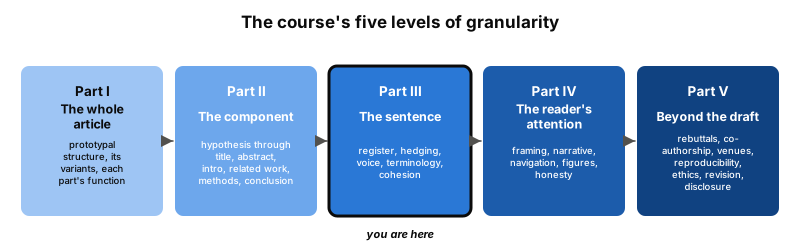
Table of contents
- A. Formal academic register vs. casual writing
- B. Hedging and epistemic stance: avoiding overclaiming and underselling
- C. Active vs. passive voice, and when each serves the argument
- D. Precision and consistency in terminology
- E. Cohesion and transitions between sentences and paragraphs
- F. Common lexical pitfalls: redundancy, verbosity, weasel words