F. From draft to camera-ready: revision and editing strategies
Revision is not proofreading
Revision and proofreading are commonly performed as one operation, at one time, and the merger is expensive. Proofreading corrects errors within sentences that are staying. Revision decides which sentences stay, which sections exist, and whether the argument holds — and it operates at three scales that correspond to the parts of this course: the article and its components (Parts I and II), the sentence (Part III), and the reader’s attention (Part IV). Treating these as one pass produces the characteristic experience of polishing prose that is later deleted.
The order of the passes is fixed by dependency
The three scales must be worked in a fixed order, and the constraint is not stylistic. Sentences in a section that will be cut are wasted work, so the structural pass precedes the sentence pass; and the attention pass depends on the structure being settled, since headings, framing, and figures are navigational surfaces over a structure that must exist before it can be navigated. The common instinct runs the other way, because sentence-level revision is the most immediately satisfying and the least threatening: it never concludes that a section has to go.
The checks this course has accumulated
Every section of this course from II.A onward has ended with a check, and assembled in dependency order they constitute a revision protocol rather than a list. Presenting them together is the one place a course can do something an article cannot, since the checks were introduced where their subject matter belonged and are used at a single point in time.
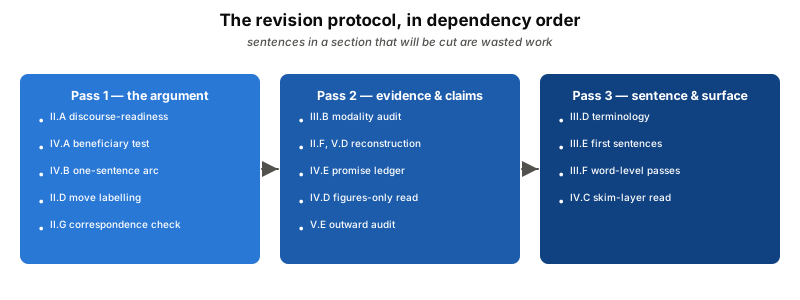
Pass one — the argument. Begin with II.A’s discourse-readiness test: can the central claim be stated and briefly justified without pointing to any section? Then IV.A’s beneficiary test, naming the reader who is worse off if the article does not exist, and IV.B’s one-sentence arc — X was believed or needed; this article shows or provides Y; therefore Z. Then II.D’s move labelling, assigning each Introduction paragraph to one of the four moves, and finally II.G’s correspondence check, placing the Introduction’s contribution list beside the Conclusion’s first move item by item. A failure at this stage changes what sections exist.
Pass two — the evidence and what is claimed of it. Run III.B’s modality audit: for every claim-bearing sentence, name the evidence in Results that licenses it and the strength that evidence supports, then check the verb. Run II.F’s reconstruction test on the Method and Experiments, and V.D’s stronger version of it with an outside colleague. Run IV.E’s promise ledger, listing every promise the Title, Abstract, first figure, and Introduction make and naming what keeps each. Run IV.D’s figures-and-captions-only read. Then V.E’s outward audit of every claim about someone else’s work. A failure at this stage changes what is claimed, or what evidence is reported.
Pass three — the sentence and the surface. Run III.D’s terminology inventory, which V.B showed is also the collaborative seam check. Run III.E’s first-sentence extraction, section by section. Run III.F’s two mechanical passes — the subtractive test on every qualifier and intensifier, and the string audit for “significantly,” “clearly,” “it is widely believed,” “recent work has shown,” and the rest. Run IV.C’s skim-layer read of headings, captions, and first sentences. A failure at this stage changes sentences, which is why it comes last.
Instruments
Independent of the checks, a few mechanical devices make failures visible that rereading does not. Reading aloud catches the sentence whose clauses do not resolve, and is the only reliable detector of III.C’s voice problems. Time away — a day, ideally more — restores enough distance to read what is on the page rather than what was intended, which is the condition every check above assumes and none can create. Printing the article, or reading it in a different format, defeats the familiarity that develops with a specific on-screen layout, and is also when IV.D’s legibility failures appear. And a reader from outside the project, given the article and no explanation, is the only instrument that detects what the authors cannot know they assumed.
Camera-ready is a distinct operation
Acceptance converts the response written under V.A into a list of obligations, and the camera-ready’s primary job is to discharge them. The camera-ready’s obligation is the response’s promises, in the order in which they were promised, and this is worth stating because the available time is invariably shorter than the list of improvements the authors have thought of since submission. A promise made in a response and not kept in the camera-ready is visible to any reviewer who checks, and reviewers do check.
The remaining operations are mechanical and easy to forget: de-anonymizing author names, affiliations, and self-references, which V.C noted must be written so that the neutral form survives both states; adding Acknowledgments, which I.C identified as the one component with a purely social function and which is therefore the one whose omission causes harm outside the argument entirely; and using the additional page most venues grant at this stage. That extra page should be spent on the promises first and on the material the authors wanted to add second — an ordering that is easy to state and consistently difficult to follow.
Matching to the structural variant
The three variants from I.B fail differently under time pressure. The system/method paper most often carries promised additional baselines or ablations into the camera-ready, which are the most expensive promises to keep and should therefore be the ones most carefully scoped when the response is written. The empirical/analysis paper most often carries promised scope corrections — a claim narrowed, a Limitations paragraph added — which are cheap to make and easy to forget, since nothing in the article visibly breaks if they are not. The resource/dataset paper most often carries documentation obligations from V.D’s checklist, which take longer than they appear to and are frequently discovered at the camera-ready deadline rather than at submission.
A worked example
Returning to the four review points from V.A: the seed variance moves into the main results table, the Abstract’s phrasing is scoped to the language tested, the capability sentence is replaced with the behavioral one, and the proposed domain-shift experiment is named in the Conclusion’s third move as an open question rather than performed. Four promises, four locations, all identified before the camera-ready began. The instructive part is what each triggers. Moving the variance into the main table changes a figure caption, which IV.D requires be a claim rather than a label. Rescoping the Abstract triggers II.G’s correspondence check, since the Conclusion restates the Abstract’s claim. Replacing the capability sentence triggers III.D’s terminology inventory, because the replacement term must be used consistently wherever the old one appeared. One promise rarely changes one sentence, which is the argument for keeping the camera-ready’s task list explicit rather than working from memory.
Common failure modes
Sentence-level revision performed first is the root failure and the most expensive. Beyond it: the camera-ready spent on new material while a promised revision goes unmade; the extra page filled because it is available rather than because something needs it, which III.F’s economy argument covers directly; de-anonymization performed on the author block but not on the self-references in Related Work; the acknowledgment of funding omitted, which has consequences outside the article entirely; and revision performed without any interval away from the draft, which does not fail visibly and quietly halves the yield of every check above.
A practical check
Before beginning the camera-ready, write the promise list from the response as a table with one row per promise and one column naming the exact location that will change. Work it top to bottom, and treat anything not on the list as optional. When the list is complete, run pass three from above once more over only the paragraphs that changed — since the most common way a camera-ready introduces a defect is a repair made in one section and not propagated to the two others that used the same term.