C. Guiding the reader: signposting, questions, and the nonlinear read
What III.E left open
Section III.E treated signposting as the section-level counterpart of the sentence-level connective: a device asserting a relation, useful in a long Method or where Related Work is deferred, and a symptom when it becomes load-bearing. That treatment assumed a reader proceeding forward through the text, which is what a cohesion analysis must assume. This section drops the assumption. It also takes up rhetorical questions, which III.E did not touch at all, and which are the one engagement device in this part that is more often harmful than helpful.
The reading path is not the article’s order
Very few readers read an article the way it is written, and the ones who matter most read it least linearly. A reviewer typically reads the Abstract, then the figures and tables, then the Introduction and Conclusion, then returns to the Method and Experiments with specific doubts already formed. A conference attendee decides in under a minute, from a title and a first figure, whether to read further. A reader who arrives from a citation enters at whatever section the citing article pointed them toward, often the Method or a single results table, with no context from anything before it. Each of these is a legitimate reading, and none of them is the sequence the article was written in.
The consequence is that an article has, in effect, several entry points and several reading orders, and the devices this section describes are the interface for readers who are not where the writer imagined them. This does not license repetition or redundant summary — the article is still one argument. It means that the article’s navigational surfaces carry more traffic than its prose, and are typically drafted with less care than any other part of it.
The skim layer is a designed artifact
Certain elements of an article are disproportionately read: the title, the section and subsection headings, the enumerated contributions list where there is one (I.B, II.D), the first sentence of each paragraph, and the figure and table captions. Taken together these form a layer that a substantial fraction of readers will consume in full while consuming almost none of the prose between them. That layer is either designed or residual, and in most drafts it is residual.
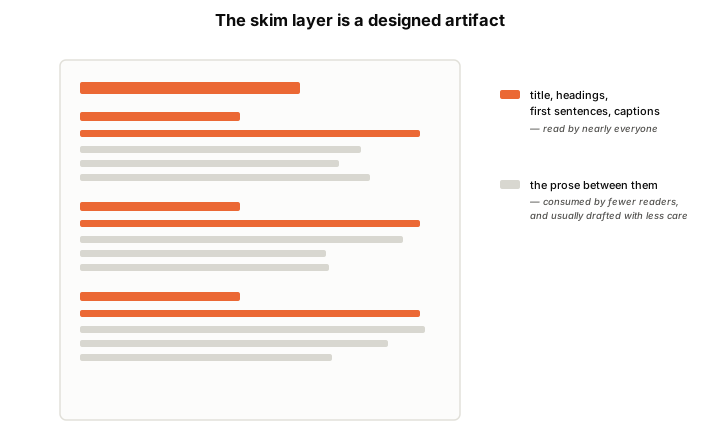
Headings are the clearest case, because they are the highest-traffic navigational slot in the article and are conventionally filled with the least informative available content. A heading that names a genre spends the article’s most-read navigational slot on information the reader already had. “Experiments” tells a reader only that experiments are described below, which they could have inferred from the article being an empirical one; “Evaluating on out-of-distribution splits” tells them what was done and lets them decide whether this is the section they came for. The objection that venues expect conventional section names is largely answered by subsections, which are almost never constrained, and where a venue does mandate top-level names the same information can be carried one level down. Topic sentences are the second case, and III.E’s practical check — reading only the first sentence of every paragraph — is best understood not merely as a diagnostic but as a description of how the section will in fact be read by some of its readers.
Rhetorical questions, and when one earns its place
Questions in scientific prose have a poor reputation, and mostly deserve it, but the failure is not uniform across kinds. Three uses are worth distinguishing.
- The question that states the research question. “Do models that achieve high benchmark accuracy perform entailment reasoning, or do they exploit syntactic heuristics?” This is legitimate and clear, but rarely superior to the declarative form II.B already asked for; a research question stated as a question is not thereby better formulated, and the interrogative can obscure whether the question is falsifiable.
- The section-opening question the section answers. An ablation subsection headed by whether the improvement comes from the architecture or from the additional training data is a strong use, because it converts a heading into a statement of the section’s function and makes the section’s contribution to the argument explicit at the moment the reader enters it. This is the use that repays the space.
- The decorative question. “But is accuracy really the right metric?” — asked, not answered, and answered in the reader’s mind before the sentence ends. This costs a sentence, asserts a doubt the article does not resolve, and invites a reader to supply their own answer, which may not be the article’s.
The rule separating them: a question earns its place when the text answers it and the reader could not have supplied the answer. Both conditions are needed, and the second is the one most often failed. A fourth use is worth naming separately because it is the strongest and the least common: a question in the Discussion that states an objection a sceptical reader is already forming, immediately before the article addresses it. That device does real work, since it demonstrates that the objection was anticipated rather than overlooked, and it connects directly to the anticipation of reviewer objections taken up in Part V.
Forecasting sentences and their cost
Sentences that announce what a section will do — “this section describes the annotation procedure and reports agreement” — buy nonlinear access at the price of redundancy, and the exchange rate depends on length. In a six-page Method that a reader may enter partway through, the purchase is worth making. Before a two-paragraph subsection, the forecast is longer relative to what it forecasts than any summary should be, and the reader has been made to read the section twice. Section III.E’s caution applies unchanged and is worth restating in navigational terms: where a reader would be lost without the forecast, the forecast is compensating for an order that is not itself motivated, and the ordering is what should be repaired.
Matching to the structural variant
The three variants from I.B place different loads on these devices. The system/method paper leans hardest on structural signposting, as III.E observed, because its Method is subdivided by component and the subdivision carries much of the ordering; its headings are therefore doing navigational work already, and the improvement available is mostly in making them descriptive rather than generic. The empirical/analysis paper benefits most from questions as headings, since its subsections typically correspond to sub-questions of the research question, and naming each one converts the article’s structure into a visible decomposition of its argument. The resource/dataset paper should map its headings onto the questions a prospective user arrives with — what the resource contains, how it was built, how reliable it is, and what can be done with it — because its readers are the most likely of the three to arrive with a specific question and no intention of reading the article through.
A worked example
The HANS study’s material, organized under generic headings, would run: Introduction, Related Work, Dataset, Experiments, Results, Discussion. Every one of those headings is true and none is informative. Rewritten to describe content: “Three syntactic heuristics a model could exploit,” “Constructing cases where heuristics and entailment diverge,” “Models trained on MNLI, evaluated on HANS,” “Where accuracy collapses, and where it does not.” A reader who reads only these four headings has the argument — the heuristics, the construction that isolates them, the evaluation, and the failure — and a reader looking specifically for how the diagnostic was built knows exactly where to enter. The generic version supports neither reader, and the two versions describe identical content.
The skim layer can be checked the same way. Reading only the first sentences of a well-drafted Results section should yield something like: the models tested reach near-baseline accuracy on the standard benchmark; on the diagnostic set they fall to near chance; the collapse is consistent across all three heuristics; the one condition where accuracy survives is the one where the heuristic and the correct label coincide. That is four sentences, extracted mechanically, and it is the section’s argument. Where the same extraction yields four facts with no argument between them, the paragraphs have no topic sentences, and the skim layer does not exist.
Common failure modes
The genre-naming heading, discussed above, is nearly universal and nearly free to fix. Beyond it: the reflexive forecast, where every section opens with “In this section, we…” regardless of the section’s length, until the construction carries no information and readers skip the first sentence of every section as a matter of habit — which is expensive, since that is exactly where topic sentences live. Over-forecasting a short subsection is the same failure measured against length. Questions the article never answers are the decorative case above, and they are worse than a wasted sentence because a reader who notices one unanswered question begins reading subsequent questions as ornament. Finally, the cliff-hanger — “but as the next section shows, this is not the whole story” — imports the one narrative device IV.B specifically excludes, and it does so in the article’s navigational layer, where withholding is most directly opposed to the layer’s purpose.
A practical check
Read only the title, the section and subsection headings, the figure and table captions, and the first sentence of each paragraph, in order, and nothing else. The article’s central claim, the evidence for it, and its principal limitation should all be recoverable from that reading alone. This is the multi-layer extension of III.E’s paragraph-level check, and it is more demanding for a reason: III.E’s version tests whether a section coheres for a reader going through it, while this one tests whether the article survives a reader who never goes through it at all. The second reader is more numerous.