C. Adapting an article to different venues
A venue is a reader population, not a format
Adapting an article to a new venue is usually experienced as a formatting task, and formatting is the least of it. A venue is a set of readers with shared expectations about what counts as a contribution, what background may be assumed, and which comparisons are obligatory. Section IV.A established that a framing selects a reader population; a venue is a reader population, so the venue decision and the framing decision are the same decision made twice, and the second one is constrained by the first. An article framed as an efficiency contribution and submitted to a venue whose readers evaluate accuracy has not been mis-formatted; it has been addressed to the wrong people.
Conference and journal are different review instruments
The structural difference between the two dominant NLP publication routes is not prestige or length but whether revision is part of the process. At ACL Rolling Review, submissions run on a two-month cycle and receive at least three reviews and a meta-review; authors may respond, and the reviews are then carried to a venue through a separate commitment step, where the venue makes its own decision. There is no round in which an editor requires a change and then reconsiders. At TACL, a standing committee of action editors handles papers individually, and the available outcomes include conditional acceptance, where publication follows specified revisions within two months, and rejection with an invitation to resubmit within three months — a category the action editor may choose precisely to enable iteration. TACL publishes conference-length papers, accepts submissions on rolling monthly deadlines, and its papers are eligible for optional presentation at ACL-sponsored conferences.
The consequence for writing is direct. A conference article must be right at submission, because no mechanism exists to make it right afterwards; every gap the authors know about will either be excused in Limitations or held against the article. A journal article can carry an argument that an editor is able to require be repaired, which changes what it is reasonable to attempt — a longer argument, a more ambitious claim, a more complete treatment of prior work — because the process contains a step in which incompleteness is remediable rather than fatal.
What adaptation changes is the compression ratio, not the discourse
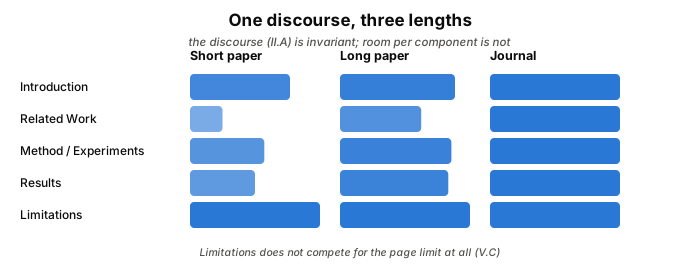
Section II.A’s discourse paragraph is invariant across venues. The problem, the gap, the approach, the finding, and the implication do not change because the page limit did. What changes is how much room each component gets, and the components do not scale uniformly. Related Work expands most in a journal, where the obligation to situate the work fully is stronger and the space exists to discharge it. Method and Experiments expand next, toward the reconstruction standard II.F set, which a conference page limit frequently forces below what a reader would need. The Introduction expands least; II.D’s four moves need the same four moves at any length, and an Introduction that doubles in length usually does so by re-establishing territory that IV.A already identified as the cheapest content in the article.
Compression works the other way and is harder. Reducing a long paper to short-paper length is not a matter of cutting proportionally: a short paper supports one claim, so the operation is to identify which of the article’s claims is the contribution and delete the others outright, rather than to shorten all of them until each is too thin to support.
The page limit is a functional constraint
At ARR, long papers are limited to eight pages of content and short papers to four, with references unlimited and excluded from the count. The Limitations section is mandatory, must be titled “Limitations,” must appear before the references, does not count toward the page limit, and its absence is grounds for desk rejection. An optional ethics statement is likewise excluded from the count.
These exclusions refine an argument III.F made. That section observed that verbosity is a reallocation of space away from the components that carry the argument — the differentiation sentence II.E requires, or the protocol-derived limitations II.H asked for. The first half of that claim stands: words spent on redundancy are words unavailable to the differentiation sentence, which competes for the same eight pages. The second half needs correcting, and the correction is useful. Limitations does not compete for that space at all, which removes the commonest excuse for a thin one. An article whose Limitations section is three generic sentences did not run out of room; it ran out of derivation, which is precisely what II.H said the section required.
Anonymity and preprints
ARR uses two-way anonymized review: submissions must not contain author names or affiliations, and self-references must not reveal identity. There is at present no anonymity period — non-anonymous preprints may be posted while a paper is under review — though authors may opt into a binding commitment not to preprint, which carries incentives at the venue level. Supplementary material must also be anonymized, and links to cloud storage services are prohibited, which is the same self-containment requirement V.A identified in the response format and is worth planning for rather than discovering at submission.
The writing consequence of anonymization is small but real: the sentence that says “in our earlier work we showed” has to be rewritten so that it neither breaks anonymity nor pretends the prior work is unrelated, and the neutral third-person form is the one that survives review and camera-ready without further change.
Style guides are the shallow layer
Template requirements, citation formats, section-numbering conventions, and figure placement rules are real obligations and take an afternoon. They are not what adaptation means, and treating them as though they were is the failure this section exists to prevent. The deep layer is the venue’s expectations about components: which sections its readers expect to find, how much Related Work is enough, whether negative results are publishable, whether a resource paper needs baseline experiments, and how much of the Method may be deferred to an appendix. These expectations are learned by reading the venue’s recent proceedings, which is a slower operation than reformatting and the only one that changes whether the article fits.
Matching to the structural variant
The three variants from I.B travel differently. The system/method paper transfers most easily between conference venues, since its claim is comparative and comparative claims are legible everywhere, but it expands least usefully into journal length — beyond a point, more architecture description does not strengthen a comparative claim. The empirical/analysis paper gains the most from journal length, because III.E observed that its argument lives in the linkage between findings, and linkage is what page limits cut first. The resource/dataset paper is the most venue-sensitive of the three, since some venues treat a resource as a first-class contribution and others require it to be accompanied by an empirical finding, and that expectation determines whether the baseline experiments I.B described as “a usability demonstration rather than a competitive comparison” are sufficient or not.
A worked example
One discourse, three lengths. At short-paper length, the syntactic-diversity article supports exactly one claim — that syntactic diversity yields a gain over a domain-matched corpus of equal size — with one table, no ablation, and a Limitations section that is not shortened, because it does not count against the limit. At long-paper length the same discourse supports the claim plus the analysis that locates the gain in constructions absent from the matched corpus, an ablation separating diversity from corpus size, and a Related Work section with a differentiation sentence per cluster. At journal length it additionally supports a second language, the cross-lingual comparison that becomes possible with it, and a treatment of prior work on data selection that a conference version can only gesture at.
What must not change across the three is the claim’s strength. The short version’s single table licenses exactly what III.B’s ladder says it licenses, and a writer compressing a long paper into a short one is under continuous pressure to keep the long version’s conclusions while dropping the evidence that supported them. That is the specific way venue adaptation produces overclaiming, and it is invisible unless the compressed draft is re-audited against the evidence it actually retains.
Common failure modes
The resubmission that changes only the template is the most common, and it is a rational-seeming response to a rejection whose reviews said nothing the authors accepted; its cost is a second cycle spent to receive the same reviews. Beyond it: cutting Limitations to fit, which at ARR is both unnecessary and grounds for desk rejection if carried far enough; cutting Related Work instead, which II.E’s failure list already covers and which reads to a specialist reader as unfamiliarity with the space; the venue-mismatched framing IV.A predicted, submitted unchanged after a rejection that was actually a population mismatch; and the compression that preserves conclusions while dropping evidence, described above, which is the one that does lasting damage because it survives into publication.
A practical check
Before adapting, write down which of the article’s claims the target venue’s readers will consider the contribution, and which comparisons they will consider obligatory — from the venue’s recent proceedings rather than from memory. Then check the current draft against both lists. Claims the venue’s readers will not value are candidates for compression; obligatory comparisons the draft lacks are the actual adaptation work, and neither appears in any style guide.