Part V. Advanced Topics in Scientific Article Writing
Part V has treated seven contexts that Parts I through IV excluded by assumption, and the argument in each was the same. A response to reviewers is a text with two readers who need different things, and it is written well by writing for the one who decides. A co-authored draft leaves seams at exactly the joins where I.C’s components depend on one another, which is why the division of labour is a writing decision. A venue is a reader population, so adaptation is a question about which claims that population values rather than about templates. A reproducibility checklist is the Method’s reconstructive function made auditable, and its demand for reported variance is the third independent derivation of a requirement III.B and IV.D reached from rhetoric and from graphics. Ethical writing is the claim that a citation, an example, and a research question all carry an evidential status that the text must not misstate. Revision is three passes in a fixed order, and camera-ready is the discharge of promises already made. And the disclosure regime turns out to rest on the same criterion the whole taxonomy rested on: that someone must be answerable for the claims.
None of these required a new framework, which was the point. The course’s rhetorical angle was introduced in Introduction.md as a claim about transfer — that a functional account outlasts any venue’s style guide — and Part V is where that claim was tested against material ordinarily transmitted as professional lore. What remains is to state what the account came to, and where it stops, which Conclusion.md takes up.
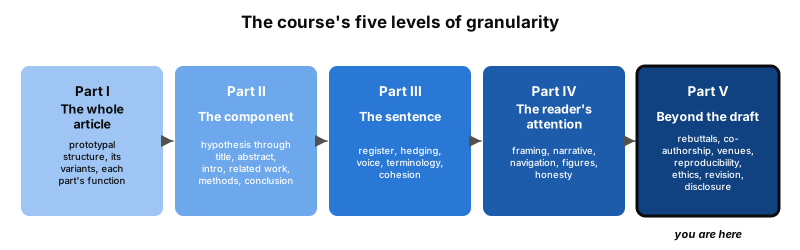
Table of contents
- A. Writing rebuttals and responding to reviewers
- B. Collaborative writing and the seams it leaves
- C. Adapting an article to different venues
- D. Reproducibility statements and supplementary material
- E. Ethical writing: citation practices, attribution, and the Limitations section
- F. From draft to camera-ready: revision and editing strategies
- G. Writing assistance and disclosure