Part IV. Engaging the Reader
Part IV has treated five instruments — framing, narrative, navigation, visualization, and the promise rule that constrains the other four — and the argument connecting them is the one this course has made at every scale. Attention is a resource the reader spends, and each of these instruments is a way of not wasting it. Framing gives the reader a reason to begin, by locating a consequence rather than asserting importance. Narrative gives them a reason to continue, by installing an expectation the finding will answer. Signposting and questions give them the means to navigate an article they will not read in order. Figures give them the fastest available path to the claim, and are read by more people than the prose is. And the promise rule keeps all four answerable to the evidence, which is what distinguishes engagement from the undue persuasiveness Introduction.md warned against at the outset. None of these is decoration, and the diagnostic that has recurred since I.C applies here too: when a passage fails to hold a reader, the productive question is which of these functions it is failing to serve.
Parts I through IV describe an article as a text: written by one writer, addressed to one reader, and finished when it is submitted. All three assumptions are false in practice. Articles are written by several people whose contributions must be reconciled; they are judged by reviewers who respond in writing and must be answered in writing; they are adapted across venues with different lengths, formats, and expectations; and they carry obligations — of citation, of reproducibility, of scope — that outlast the argument they make. Part V takes up these contexts, treating each as an extension of the same functional analysis rather than as a separate body of professional lore.
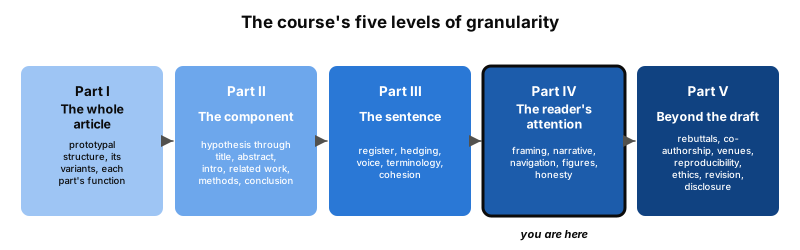
Table of contents
- A. Framing the contribution: why the reader should care
- B. Narrative structure: what storytelling transfers, and what it does not
- C. Guiding the reader: signposting, questions, and the nonlinear read
- D. Figures and visualizations as engagement tools
- E. Balancing rigor and excitement without overselling