E. Locating the article within Related Work, and differentiating efficiently
From gap to full argument
Section II.D deferred a piece of work: the Introduction names the gap in a sentence or two, but the fuller argument — why existing approaches fall short, in what specific ways, against which specific prior work — was left for Related Work to carry out. This section addresses that fuller argument directly, and asks what it takes to write it so that it actually does the bounding work I.C assigned to it, rather than merely listing what has been published before.
Serving two readers at once
Section I.C noted that Related Work serves two readers simultaneously, and a well-written section keeps both in view. One reader is trying to decide whether the article’s problem has already been solved, and needs to be told, plainly, what the closest existing approaches do and do not achieve. The other reader is attributing credit for prior ideas, and needs the article’s debts to existing work stated accurately, including debts to work the article’s own approach builds on rather than merely resembles. Related Work sections most often shortchange the first reader, since the second reader’s need — citing the relevant papers — is easy to satisfy by listing them, while the first reader’s need — knowing whether the problem is already solved — requires an argument that a mere list does not supply.
Organizing by dimension, not by chronology or by paper
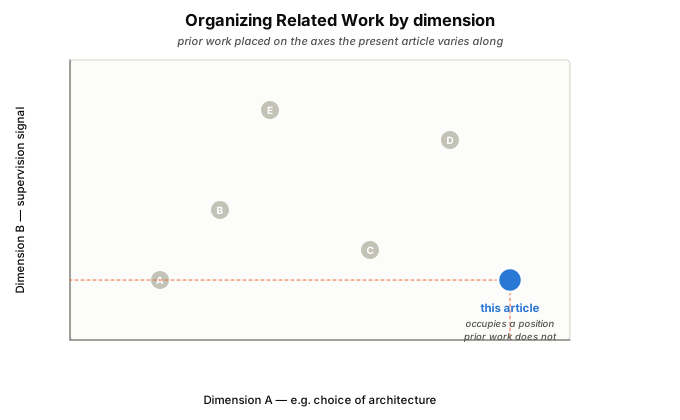
The default failure mode is the annotated bibliography: a paragraph per prior work, each summarizing what that work did, with little connecting one paragraph to the next or to the article’s own contribution. This satisfies the credit-attribution reader and fails the first, since a reader can read the whole section and still not know how the present approach relates to any of it. The alternative this section recommends is to organize by dimension: identify the two or three axes along which existing approaches to the problem actually vary — a choice of architecture, a choice of supervision signal, a choice of what is being measured — and group prior work under those axes rather than under its own chronology or authorship. The present article’s approach is then placed explicitly within the resulting space, occupying a position on those same axes that existing work does not occupy. This is the same taxonomy-building move I.B described for the system/method paper, where Related Work is compressed into a taxonomy of competing approaches so that each becomes a named baseline later — the technique generalizes beyond that one structural variant.
The differentiation sentence
Whatever the organizing scheme, each cluster of prior work needs an explicit sentence stating how the present article differs from it, and why that difference matters for the central claim from II.B — not just a description of what the prior work does. This sentence is usually what a reader skimming the section actually extracts, and leaving it implicit, trusting the reader to infer the difference from a juxtaposition of descriptions, is the single most common way an otherwise well-researched Related Work section still fails to differentiate the article efficiently. A useful test while drafting: for every prior work or cluster discussed, there should be a sentence that could stand on its own as an answer to “how is this article different, and why does that difference matter here” — if no such sentence exists, one is missing, not implied.
A worked example
The Transformer paper (I.B) organizes its prior work by exactly one dimension relevant to its own contribution: how a model relates signals between two arbitrary positions in a sequence. Recurrent models are placed on this dimension as processing positions sequentially, an inherently serial operation that limits parallelization. Convolutional approaches such as ByteNet and ConvS2S are placed on the same dimension as requiring a number of operations that grows with the distance between positions — logarithmically for one, linearly for the other. The differentiation sentence follows directly from this placement: self-attention relates any two positions in a constant number of operations, independent of distance, which recurrent and convolutional approaches cannot do. Notice what makes this sentence effective — it is stated on the same axis used to place the prior work, it names a specific, checkable property (number of operations as a function of distance) rather than a vague claim of superiority, and it explains why the difference matters for the article’s actual contribution: a model intended to make long-range dependencies easier to learn. A comparison table built from this same axis — one row per family of approaches, one column stating how each relates distant positions — would make the same argument visually, and is exactly the kind of table this section recommends building while drafting, whether or not it survives into the final article as a figure.
Where Related Work belongs
Section I.A already noted that Related Work is sometimes placed early, right after the Introduction, and sometimes deferred to just before the Conclusion, and the choice is not arbitrary. Early placement orients the reader in the existing landscape before any technical content is presented, which suits a reader who needs that orientation to follow the Method at all. Deferred placement lets the reader engage with the article’s own approach and results first, then evaluate the positioning claim with the technical detail already in hand — often the better choice when the differentiation sentence for a given prior work cannot be stated precisely without vocabulary or results the article has not yet introduced. Venue and subfield convention weigh heavily here, but the underlying test is the same either way: place Related Work wherever the differentiation sentences can be made most precise.
Matching to the structural variant
The three structural variants from I.B shape Related Work as they shape everything else. In the system/method paper, it is compressed into the taxonomy of competing approaches described above, chiefly so that each becomes a named, citable baseline in the Experiments section. In the empirical/analysis paper, it is often woven directly into the Analysis section rather than isolated on its own, since prior findings are frequently the direct object of comparison — the thing being confirmed or overturned — rather than background to be cleared before the real argument starts. In the resource/dataset paper, it is frequently retitled Related Datasets or Related Resources and organized as a direct comparison to prior resources along dimensions such as scale, language or domain coverage, and annotation type, often condensed into the comparison table already noted among that variant’s common apparatus in I.B.
A concrete tool: the comparison table
That comparison table is not specific to resource papers; it is a useful drafting tool for any variant. Listing, in rows, the dimensions identified while organizing Related Work by axis, and in columns, the present article alongside its closest prior approaches, forces the differentiation sentence for each row to be stated in checkable terms rather than in prose vague enough to elide an axis where the present work does not actually differ. Whether or not the table survives into the final article as a figure, building it while drafting is a reliable way to catch a Related Work section that has slipped into annotated-bibliography mode.
Common failure modes
Beyond the annotated bibliography and the missing differentiation sentence already discussed, three further failures recur. Related Work can adopt a dismissive tone toward prior approaches to inflate the apparent size of the present contribution — a tone failure taken up more fully in Part III, and one that damages credibility with any reader who knows the cited work well. Related Work can selectively omit prior work that is inconvenient for the novelty claim, which is not merely a stylistic weakness but an integrity issue addressed again under ethical writing in Part V. And Related Work can under-cite the adjacent literature a specialist reader would expect to see acknowledged, which reads less as an argument for novelty and more as unfamiliarity with the space the article claims to be contributing to.