Introduction
Rationale
The quality of a piece of research and the quality of its written account are logically independent: sound results can be obscured by an unclear article, and a well-constructed article can lend undue persuasiveness to weak results. This course isolates the second variable. It treats scientific writing as a distinct competence, governed by its own norms and open to deliberate instruction, rather than as an incidental by-product of doing research.
Angle
Two broad pedagogical approaches to teaching scientific writing can be distinguished. A prescriptive approach specifies a fixed template — a canonical sequence of sections and a corresponding set of stylistic rules — and treats writing as compliance with that template. A rhetorical, or functional, approach instead treats each component of an article as serving a communicative function within an argument, and treats structure and style as choices made in service of that function.
This course adopts the rhetorical approach. The justification is threefold:
- Transfer across venues and subfields. Section names and formatting requirements vary across venues (conferences, journals, workshops) and across subfields within Natural Language Processing (NLP). A rule such as “the introduction must contain four paragraphs” does not transfer; the function those paragraphs typically serve — establishing a problem, situating it in the literature, stating a gap, and asserting a contribution — does. Teaching function over form yields writing skills that outlast any one venue’s style guide.
- Fit between structure and argument. Not every contribution fits the same argumentative shape. A negative result, a survey, a position paper, and a system paper make different kinds of claims and are best served by different distributions of emphasis across sections. A purely prescriptive template cannot represent this variation; a functional account of what each section is for lets the writer decide, case by case, how much space and what content a given section warrants.
- Diagnostic power. When a piece of writing is unclear, “which rule was broken” is rarely the most useful question, since the writing may be rule-compliant and still fail. “Which function is not being served” is more often the productive diagnostic, and it is only available under a functional account of structure.
The corollary of this angle is methodological: rather than presenting rules to be memorized, the course repeatedly returns to worked examples — published articles and, where useful, existing writing courses — and asks what communicative work each choice of structure, tone, or emphasis is doing. Rules are derived from this analysis where they hold, and are marked as conventions of degree rather than requirements where they do not.
Scope
Examples throughout the course are drawn primarily from NLP, both because it is a field with a comparatively stable set of venues (ACL, EMNLP, NAACL, and related) and because it allows the course to ground abstract claims in a shared, recognizable corpus of articles. The functional framework itself is not specific to NLP and should transfer to other empirical, experiment-driven fields with only minor adjustment.
The course assumes the reader already has research results, or is close to obtaining them, and is preparing to communicate them in written form. It does not address the conduct of research itself, only its written account.
Structure of the course
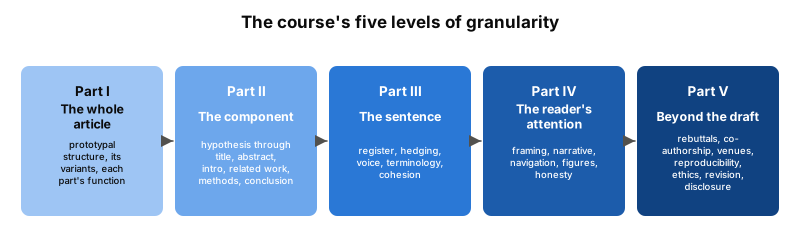
The course follows the five parts outlined in CourseSummary.md, each of which instantiates the rhetorical angle described above at a different level of granularity:
- Part I establishes the functional framework at the level of the whole article: the prototypal structure of an NLP article, concrete examples of that structure in practice, and the role played by each of its parts.
- Part II applies the framework at the level of individual sections, from formulating the hypothesis and research question through to writing the title, abstract, introduction, related work, methods, and conclusion.
- Part III descends to the level of tone and lexical choice, treating register, hedging, voice, and word choice as further instruments of the same communicative functions.
- Part IV addresses reader engagement, examining how a piece of writing sustains attention and interest without compromising the rigor established in Parts I–III.
- Part V treats advanced topics — rebuttals, co-authorship, venue adaptation, reproducibility, and the ethics of citation — as extensions of the same functional analysis to contexts beyond the initial drafting of an article.