A. Overview of the prototypal article in Natural Language Processing
The notion of a prototype
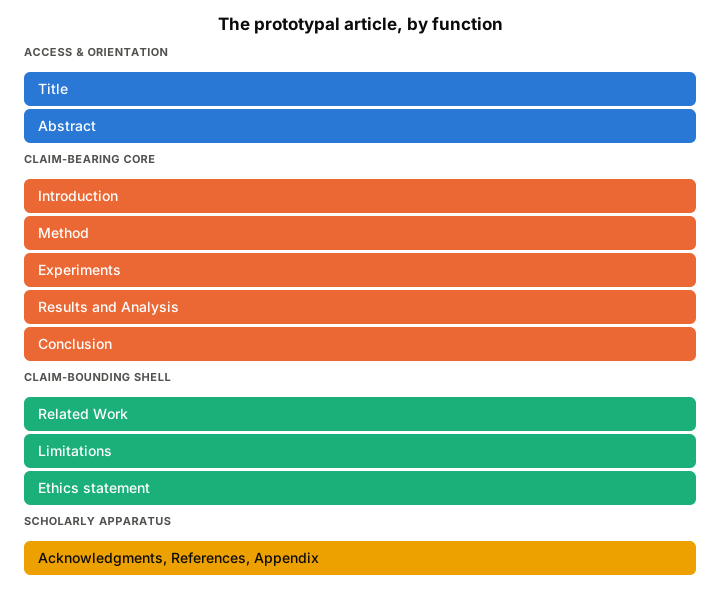
No single NLP article is representative of the field, yet a reader who has read widely in the venue can usually predict, section by section, what an unseen article will contain and in what order. This course calls that shared expectation the prototypal article: an idealized structure abstracted from the recurring practice of the field, rather than a requirement imposed by any one venue. Treating it as a prototype rather than a template matters for the angle adopted in this course (see Introduction.md): the prototype is a starting point for identifying the communicative function each part typically serves, and deviations from it are then judged against that function rather than against the prototype itself. Sections I.B and I.C examine, respectively, concrete deviations and the functions in more detail; this section only lays out the structure itself.
The macro-structure
The prototypal NLP article follows the empirical-sciences tradition broadly known as IMRaD (Introduction, Methods, Results, and Discussion), specialized to the conventions of the field. In its current, extended form, it typically comprises the following components, in order:
- Title — a compressed statement of the contribution.
- Abstract — a self-contained summary of the problem, approach, and findings.
- Introduction — the motivation, problem statement, and a preview of the contribution.
- Related Work — the article’s position relative to prior work, sometimes merged into the Introduction or deferred to just before the Conclusion.
- Method / Approach — the technical content: models, algorithms, datasets, or theoretical framework.
- Experiments — the experimental protocol: data, baselines, metrics, and setup.
- Results and Analysis — the findings, and their interpretation.
- Conclusion — a restatement of the contribution and its implications.
- Limitations — an explicit account of the scope and shortcomings of the work, now required by most major NLP venues.
- Ethics statement — a discussion of the ethical considerations raised by the work, required by an increasing number of venues.
- Acknowledgments, References, Appendix — supporting material outside the main argumentative line.
Components 9 and 10 are comparatively recent additions to the prototype: they were largely absent from NLP articles before the field’s broader turn toward reflecting on the societal impact of its methods, and their inclusion is itself an instance of a venue’s expectations reshaping the prototype over time.
Reading the macro-structure functionally
Two features of this structure are worth noting before treating any of its parts individually.
First, the order of presentation does not match the order of composition or discovery. The Introduction is read first but is rarely written first, and it routinely presents the contribution as a settled conclusion reached before the experiments that, historically, produced it. The prototype is an artifact of exposition, not a record of the research process.
Second, the components above are not of equal argumentative weight. Some — Introduction, Method, Results — carry the article’s central claims. Others — Related Work, Limitations, Ethics statement — exist to bound and situate those claims: to state what is not being claimed, what has already been claimed by others, and what risks the claims carry. A prototypal article can be read, in this sense, as a small number of central claims surrounded by a larger apparatus whose function is to make those claims credible and precisely scoped. This distinction between claim-bearing and claim-bounding components recurs throughout the course and is developed further in section I.C.