C. The different roles of the different parts of an article
Sections I.A and I.B both stopped short of a promise they made along the way: I.A distinguished claim-bearing from claim-bounding components without examining any one of them closely, and I.B showed that the same distinction predicts which components expand or contract under three different structural variants, again without asking what, specifically, each component is for. This section makes good on that promise. It examines each part of the prototype independently of the variant it appears in, and refines the two-way claim-bearing/claim-bounding distinction into a four-way functional taxonomy.
A four-way functional taxonomy
A reader’s engagement with an article proceeds in stages, and the components of the prototype are not evenly distributed across those stages. A reader first decides, from very little text, whether to engage with the article at all. If they proceed, they read for the article’s central argument: what was done, and what was found. Around that argument, they expect to find its scope explicitly marked — what it does and does not license them to conclude. Finally, some components serve the article’s existence as a piece of scholarship rather than its argument at all. These four stages correspond to four functional categories:
- Access and orientation — Title, Abstract.
- The claim-bearing core — Introduction, Method, Experiments, Results and Analysis, Conclusion.
- The claim-bounding shell — Related Work, Limitations, Ethics statement.
- Scholarly apparatus — Acknowledgments, References, Appendix.
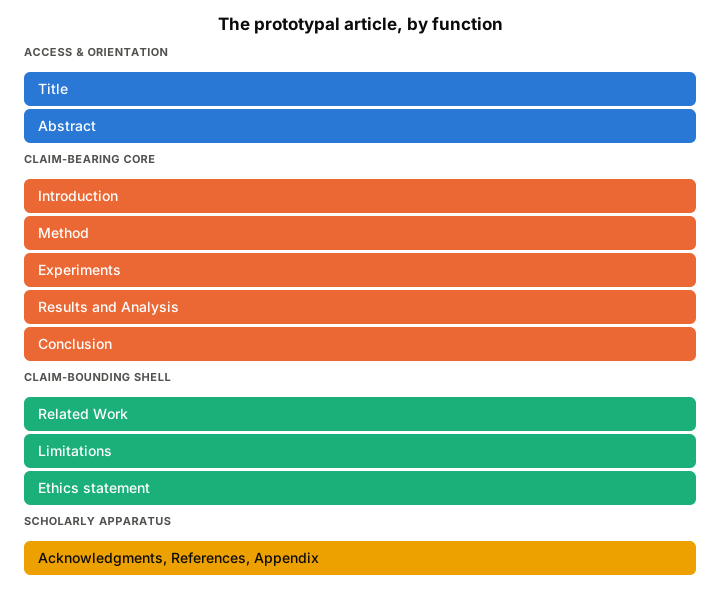
Access and orientation: Title and Abstract
The Title and Abstract are read by every reader who encounters the article, including the large majority who will read no further — in a database search result, a conference program, or a citation list. Their function is therefore not to argue but to let a reader self-select: to communicate, as reliably and compactly as possible, whether the article is relevant to that reader’s purpose. This has a direct consequence for how they must be written, developed further in Part II: unlike every other component, they cannot rely on context established elsewhere in the article, since for a large fraction of their readers no other context will ever be read. A Title or Abstract that is accurate only when read alongside the rest of the article has failed at its function, regardless of how accurate it is in that fuller context.
The claim-bearing core: Introduction, Method, Experiments, Results and Analysis, Conclusion
These five components carry the article’s central argument, but they do not all carry it the same way, and conflating their functions is a frequent source of unclear writing.
The Introduction sets the reader’s expectations before any technical content is presented: it establishes the problem, the gap in existing answers to it, and a preview of the contribution that fills the gap. Its function is anticipatory rather than evidentiary — it makes promises that the rest of the article must keep, but it does not itself constitute evidence for anything.
The Method has a reconstructive function: it must let a competent reader understand, and in principle reproduce, what was done. This is easily confused with a persuasive function, since a well-described method also tends to look more credible, but the two can come apart — a method can be described in a way that is impressive without being reconstructible, and such a description has failed at the Method’s actual job even if it succeeds at sounding authoritative.
Experiments has a narrower function that is often folded into the Method or the Results but is worth distinguishing from both: it fixes the empirical protocol — data, baselines, metrics — independently of the outcome that protocol will produce. Stating the protocol before the outcome is what makes the subsequent Results interpretable and, in principle, falsifiable: a reader can ask whether the protocol was adequate to the claim before ever seeing whether the claim was supported.
Results and Analysis carries the evidentiary function proper: it reports what happened and interprets what it means. These are functionally distinct acts — reporting is answerable to the data, interpretation is answerable to the argument — and articles most often blur this component’s function by presenting an interpretation as if it were a direct observation, a failure mode taken up again in Part III under overclaiming.
The Conclusion has a closing function: it introduces no new evidence, and instead ties the Results back to the promise made in the Introduction, stating what that promise turned out to license and what remains open. A visible mismatch between the Introduction and the Conclusion — a promise made and a different one kept — is one of the more reliable signals that an article’s central argument shifted during writing without the earlier component being revised to match.
The claim-bounding shell: Related Work, Limitations, Ethics statement
Where the claim-bearing core states what is being claimed, these three components state what is not being claimed, and by whom else, and at what risk. Their function is easy to misread as defensive — an admission of weakness — but a claim whose boundaries are not stated is not thereby stronger; it is simply harder for a reader to evaluate or safely build on, which is a cost to credibility rather than a gain.
Related Work bounds the claim by exclusion: it establishes what already exists, so that the contribution can be understood as the increment beyond it. It therefore serves two readers at once — one deciding whether the article’s problem has already been solved, and one attributing credit for prior ideas — and articles that treat it as a formality rather than as argumentative work usually shortchange the first reader.
Limitations bounds the claim by scope: it states the conditions under which the central finding does or does not hold, protecting the reader from overgeneralizing and the authors from being held to a broader claim than they intended. Section I.A already noted that this component is a comparatively recent, and now near-universal, addition to the prototype; its rise is itself evidence that the field increasingly treats explicit scoping as part of a claim’s credibility rather than as an optional afterthought.
The Ethics statement extends the same bounding function from the scope of the scientific claim to its foreseeable use and misuse, addressing a risk that Limitations, focused on scientific validity, does not cover on its own.
Scholarly apparatus: Acknowledgments, References, Appendix
These components sit outside the article’s argument rather than inside or around it, and their absence would leave the argument itself intact.
References situates the article within the citation graph of the field and makes its factual claims about prior work traceable; this is a distinct function from Related Work’s prose argument, and the relation between the two is that of a ledger to the argument built on it — Related Work asserts what prior work established, References is what lets a reader check that assertion.
The Appendix offloads material that supports the central argument without being required to follow it on a first reading — full hyperparameter tables, additional examples, proofs of secondary results — preserving the density and pace of the main components without making that material inaccessible to a reader who wants it.
Acknowledgments is the one component with a purely social and institutional function: crediting funding, assistance, or feedback. It carries no argumentative weight at all, which makes it a useful boundary case for the taxonomy — every other component’s function can be stated in terms of what it does for a reader trying to evaluate the claim, and Acknowledgments is the exception that confirms that the rule holds for the rest.
Using the taxonomy diagnostically
Because each component has a distinct function, the taxonomy above is not only descriptive but diagnostic. A Method section that becomes hard to follow because it keeps pausing to argue for its own superiority is, functionally, smuggling claim-bearing persuasion into a component whose job is reconstruction; that content likely belongs in the Introduction or Results instead. A Limitations section that reads as a list of unrelated caveats, rather than a coherent statement of scope, has typically been assembled after the fact rather than derived from what the central claim actually licenses. Locating a passage that “doesn’t feel right” against this taxonomy — asking which of the four functions it is trying to serve, and whether it is in the component that serves that function — is a recurring diagnostic used throughout Part II, which now turns to each component in turn and asks not only what it is for but how to write it well.
A worked example: mapping one article onto the taxonomy
Vaswani et al.’s “Attention Is All You Need” (I.B) illustrates how the taxonomy applies to an actual article, including a case where a component’s label does not match its function. The Title and Abstract serve access and orientation exactly as described above: a reader can decide relevance from the Abstract’s claim — a transduction model based entirely on attention, outperforming prior approaches while requiring less training time — without reading further. The Introduction, the Model Architecture section, the Training section, and the Results and Conclusion together form the claim-bearing core, carrying the article’s comparative performance claim from motivation through to evidence.
The claim-bounding shell is where the mapping is instructive rather than mechanical. The article contains a section titled “Background,” not “Related Work,” which surveys prior efforts to reduce sequential computation (extended neural GPUs, ByteNet, ConvS2S) and situates the Transformer’s self-attention mechanism against them. Functionally, this section does exactly what I.C assigned to Related Work — bounding the claim by exclusion, establishing what already exists so the contribution can be read as the increment beyond it — despite its different label. This is a direct illustration of the course’s rhetorical angle (Introduction.md): the taxonomy classifies components by what they do for the reader, not by the heading above them, and a component can satisfy a function under an entirely different name. The article has no Limitations or Ethics statement, consistent with I.B’s observation that these are recent additions to the prototype; under the taxonomy, the claim-bounding shell here is thinner than a current article’s would be expected to be, having only the Background section to occupy it.
The scholarly apparatus is present in familiar form: a References section, and an appendix of attention visualizations offloading supporting material that would have diluted the density of the Results section had it been included there. There is no dedicated Acknowledgments section separate from a brief author-contribution note, which is consistent with I.C’s observation that this component carries no argumentative weight and its absence would leave the article’s central claim entirely intact.