B. Hedging and epistemic stance: avoiding overclaiming and underselling
Hedging as bounding, at the level of the sentence
Section I.C described Limitations as bounding the claim by scope — stating the conditions under which a finding does or does not hold — and II.H insisted those conditions be derived from the protocol rather than collected as caveats. Hedging performs the same bounding function, but inside the sentence that makes the claim rather than in a separate component several pages later. This is not a redundancy: a reader encountering an unhedged claim on page two and its qualification on page nine has, for seven pages, been reading a claim stronger than the evidence supports, and may well cite it in that form. The purpose of a hedge is to make the strength of a claim legible at the moment the claim is made.
Matching modality to evidence
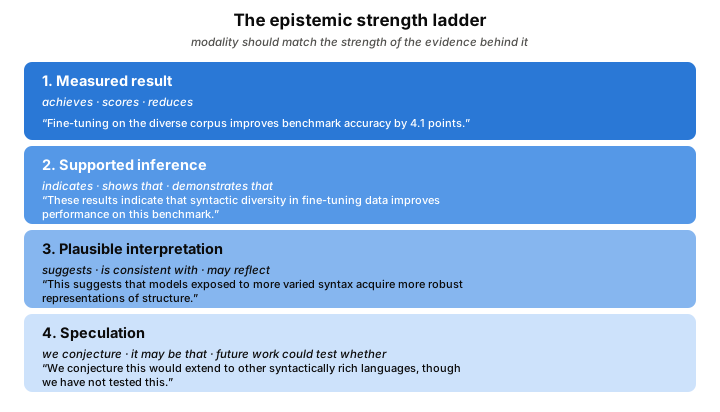
The operational rule this section proposes is a single one, and everything that follows applies it: the modality of a sentence should match the strength of the evidence behind it. Four strengths recur, and each licenses a different kind of sentence.
- Measured result. A number the article reports, obtained under the protocol fixed in II.F. Licenses a flat indicative with no hedge at all: achieves, scores, reduces. Hedging here is the underselling failure described below.
- Supported inference. A conclusion the measured results make substantially more likely, but which was not itself directly measured. Licenses indicates, shows that, demonstrates that — assertive, but grammatically marked as a step beyond the number.
- Plausible interpretation. An explanation consistent with the results but not uniquely determined by them, typically where a competing explanation has not been ruled out. Licenses suggests, is consistent with, may reflect.
- Speculation. A conjecture the article’s evidence does not bear on, appropriate only in the Conclusion’s third move (II.G) or in explicitly marked future-work statements. Licenses we conjecture, it may be that, future work could test whether.
The rule’s usefulness lies in being checkable in both directions. A sentence at strength 3 written in the modality of strength 1 is overclaiming; a sentence at strength 1 written in the modality of strength 3 is underselling. Both are failures of the same kind — a mismatch between what was found and what the sentence says was found — and it is worth naming them together, because the standard advice to “hedge more” fixes one by causing the other.
Overclaiming
Overclaiming is the failure Parts I and II deferred here three times, and it takes three recurring forms in NLP writing. The first is causal language for correlational evidence: reporting that a factor correlates with an outcome and then writing that it causes, drives, or leads to it. The second is universal language for bounded evidence: a result obtained on one dataset, one language, or one model scale, stated as a property of models in general — the failure I.B flagged as specific to the empirical/analysis paper, and the one II.G identified in Discussion sections. The third is capability language for behavioral evidence: writing that a model understands, reasons about, or knows something when what was measured is its output distribution on a task. This third form is the most insidious, because the capability word is doing real explanatory work in the writer’s own mind while the evidence supports only the behavioral claim.
The HANS study (I.B) is the field’s standing object lesson in exactly this third failure, and it is worth being precise about why. Its argument is that the field had been reading high benchmark accuracy as evidence of entailment reasoning — a strength-3 inference stated in strength-1 modality across a great many papers — and it demonstrates the gap by constructing cases where the two come apart. What makes the paper an instructive model rather than merely a critique is that its own abstract holds the rule scrupulously: “We hypothesize that statistical NLI models may adopt three fallible syntactic heuristics” marks a prediction as a prediction; “models trained on MNLI, including BERT, a state-of-the-art model, perform very poorly on HANS” states the measured result flatly, with no hedge; and “suggesting that they have indeed adopted these heuristics” marks the step from that measurement to its interpretation. Three sentences, three different modalities, each matched to what stands behind it.
Underselling
The symmetric failure receives far less attention and is nearly as damaging. Hedging a directly measured result — “our approach appears to somewhat improve performance” where a table shows a two-point gain — spends the reader’s trust on nothing, and worse, it flattens the article’s epistemic landscape: if every sentence is hedged, the hedges stop carrying information, and a reader can no longer distinguish the claims that are genuinely uncertain from the ones that are simply being reported modestly. A hedge is only informative if unhedged sentences also appear.
Section I.B recorded an asymmetry in the system/method paper without explaining it: claims of generality are hedged more than claims of measured performance. Under the rule above, this is not an inconsistency but the correct application — measured performance is strength 1 and takes no hedge, while generality beyond the tested conditions is at best strength 2 or 3. The Transformer abstract exhibits both in adjacent sentences: “Our model achieves 28.4 BLEU” is unhedged because a table supports it exactly, while “We show that the Transformer generalizes well to other tasks by applying it successfully to English constituency parsing” is a generality claim explicitly tied to the one additional task on which it was tested, rather than asserted broadly. The SQuAD abstract does the same for a resource paper: the scale and the F1 numbers are stated plainly, while the claim about downstream value — “indicating that the dataset presents a good challenge problem for future research” — is marked as an inference, since utility is exactly what a resource paper cannot measure directly (I.B).
Stance toward prior work
Section II.E deferred one further tone problem here: Related Work that adopts a dismissive posture toward prior approaches in order to inflate the apparent size of the present contribution. Under this section’s rule, that is not a separate problem of manners but the same overclaiming failure pointed outward. “Prior approaches fail to capture long-range dependencies” is a strength-1 assertion about someone else’s system, and if what supports it is a general architectural argument rather than a measurement, it is overclaimed in exactly the way an unsupported claim about one’s own results would be. The disciplined version states the limitation on a named axis and at the strength the evidence supports — the differentiation sentence II.E already asked for, which works better when it is accurate than when it is emphatic, since the readers most likely to notice an overstatement about prior work are the ones who know that work well.
Stance in the Method
The second deferred problem is evaluative language in the Method, flagged in I.C as persuasion smuggled into a component whose job is reconstruction and in II.F as something to be routed elsewhere. At the sentence level it is a stance mismatch: writing “we use a more principled objective” or “this elegant formulation avoids the drawbacks of prior approaches” asserts a comparative judgment inside a component that has presented no evidence and whose function does not include presenting any. The repair is not to hedge the evaluation but to relocate it — to Related Work as a differentiation sentence, or to Results where evidence stands behind it — and to leave the Method with a description of what the objective is and how it is computed. Note that hedging the evaluation in place (“we use an arguably more principled objective”) makes the sentence weaker without making it appropriate, since the problem was never the strength of the claim but the component it appeared in.
A worked example
Take a fixed body of evidence: an article reports that a model fine-tuned on a syntactically diverse corpus scores four points higher on one benchmark, in one language, at one model scale, than the same model fine-tuned on a standard corpus, averaged over three seeds. Four sentences, one per strength:
- “Fine-tuning on the diverse corpus improves benchmark accuracy by 4.1 points.” — Strength 1, correct: this is what the table says.
- “These results indicate that syntactic diversity in fine-tuning data improves performance on this benchmark.” — Strength 2, correct: an inference from the measurement, marked as one, and scoped to the benchmark tested.
- “This suggests that models exposed to more varied syntax acquire more robust representations of structure.” — Strength 3, correct: a mechanism consistent with the result but not isolated by it, marked with suggests.
- “Models trained on syntactically diverse data understand grammatical structure better.” — Overclaimed on all three counts named above: causal and mechanistic where the evidence is comparative, universal where it is one benchmark and one scale, and capability-attributing where the measurement is behavioral.
The last sentence is the one most likely to be quoted by a reader skimming, and the one the Limitations section will eventually contradict.
Common failure modes
Hedges can stack until they cancel out: “these results may possibly suggest that there could be a tendency toward” states nothing at all, and a reader cannot recover which of the four strengths was intended. A hedge can attach to the wrong element of the sentence — “we may have observed an improvement” hedges the observing, which is not in doubt, rather than the improvement or its interpretation, which is. And, most consequentially, a claim can be hedged in Limitations while appearing unhedged in the Abstract, which is the correspondence failure II.C identified between the two ends of the article, now visible at sentence level: the article contains both a bounded and an unbounded version of its own claim, and only readers who reach page nine encounter the bounded one.
A practical check
Take every sentence in the article that makes a claim, and name — out loud, or in a margin — the specific piece of evidence in Results that licenses it and which of the four strengths that evidence supports. Then check that the sentence’s verb and modality match. Sentences for which no specific evidence can be named are either speculation that needs marking as such, or claims that need removing. This check is most revealing when applied to the Abstract and the Introduction’s fourth move (II.D), since those are drafted before or independently of the Results in many articles, and are where mismatches most often survive revision.