E. Cohesion and transitions between sentences and paragraphs
Cohesion is not coherence
Section III.C observed that keeping one entity in subject position across consecutive sentences lets a reader follow a single thread, and deferred the point here. Before developing it, one distinction has to be drawn, because it determines what this section can and cannot fix. Cohesion is the surface linking of sentences: shared referents, connectives, parallel structure, given-before-new ordering. Coherence is the reader’s ability to reconstruct the argument the sentences are making. The two are independent, and the direction of that independence matters: a passage can be perfectly cohesive and entirely incoherent, its sentences smoothly linked and jointly establishing nothing.
This is why adding connectives to a paragraph that does not hold together does not repair it. If the sentences do not follow from one another, no “therefore” will make them, and the effect of inserting one is to assert a relation the reader can verify does not hold — which costs more credibility than the original disconnection did. When cohesion and coherence fail together, the fix is upstream: at II.A’s discourse, where the line of argument the paragraph is supposed to instantiate was either never fixed or was fixed and then departed from. This section addresses the case where the argument is sound and the surface linking is not.
Given before new
The main mechanism is a single ordering principle: put information the reader already has near the start of a sentence, and information that is new near the end. Each sentence then begins where the previous one ended, and the reader is never asked to hold an unattached new entity in mind while waiting to learn what it connects to. This is the principle III.C’s topic-position argument was appealing to without naming it, and it explains why voice matters at all — the passive is one of the instruments available for moving a given entity into subject position when the active would have put a new one there. Voice, nominalization, and clause order are all in service of this arrangement, which is why sentence-level style advice that ignores it tends to be arbitrary.
The corollary is that a paragraph is not a set of sentences but a chain, and its links are checkable one at a time: for each sentence after the first, the reader should be able to point to what in the preceding sentence its opening connects to.
The paragraph as a single move
At the next level up, the same logic applies with a different unit. Section II.D closed with a practical check for the Introduction — label each paragraph with the single one of the four moves it serves, and treat a paragraph that serves none as misplaced — and that check is the paragraph-level instance of this section’s principle rather than a device local to the Introduction. It generalizes: a paragraph carries one claim, stated in a sentence that a reader skimming would extract, and the remaining sentences support, qualify, or illustrate that claim. A paragraph that carries two claims should be two paragraphs; a paragraph that carries none is a sequence of facts that has not yet been made into an argument.
Transitions name relations, and can name the wrong one
A connective is not decoration or lubrication; it asserts that two sentences stand in a particular relation — contrast, consequence, elaboration, concession, exemplification — and it is checkable against whether they do. “However” between two sentences that do not contrast, “therefore” between two that do not entail, and “moreover” between two that are not additive are all small false claims, and a reader who notices one has been given a reason to read the next connective sceptically. Long chains of “Moreover” and “Furthermore” are a specific symptom worth recognizing: they usually mark a list of items with no logical progression among them, dressed as an argument by connectives that assert only accumulation. The repair is not a better connective but an ordering principle — by importance, by dependency, by the axes of II.E’s comparison — that makes a real relation available to name.
Signposting at the level of sections
Explicit pointers between sections (“Section 4 describes the annotation procedure”; “as established in Section 3”) do at the section level what connectives do at the sentence level, and carry the same risk. They are genuinely useful in a long Method, where a reader may enter partway through, and in an article whose Related Work is deferred (II.E), where a forward pointer tells the reader that a positioning claim is coming rather than missing. They become a symptom when they are load-bearing — when the reader would be lost without them because the order of presentation is not itself motivated. This course’s own dense cross-referencing is a deliberate exception rather than a model: a course is a reference document read out of order, whereas an article is read once, forward, by most of its readers.
Matching to the structural variant
Section I.B observed that the empirical/analysis paper’s prose “stays closer to a narrative connecting each sub-finding back to the motivating question,” which makes it the variant most dependent on cohesive work — its argument lives in the linkage between findings, not in any single number, so a break in the chain is a break in the contribution. The system/method paper relies more on structural signposting than on prose transitions, since its Method is subdivided by component (I.B) and the subdivision itself carries much of the ordering. The resource/dataset paper gets cohesion cheaply in its Data Collection section, where I.B noted the procedure is described in roughly the chronological order the resource was built, and chronology supplies a relation between adjacent sentences at no cost — but that cheapness ends abruptly at the quality-analysis and Limitations sections, which have no chronology to lean on.
A worked example
The Transformer abstract’s first three sentences form a clean given–new chain. The first — “The dominant sequence transduction models are based on complex recurrent or convolutional neural networks in an encoder-decoder configuration” — opens on the field’s models, which the reader has, and ends on two new things: the recurrent and convolutional machinery, and the encoder–decoder configuration. The second — “The best performing models also connect the encoder and decoder through an attention mechanism” — opens on models and the encoder and decoder, both now given, and ends on a third new thing, the attention mechanism. The third — “We propose a new simple network architecture, the Transformer, based solely on attention mechanisms, dispensing with recurrence and convolutions entirely” — takes the attention mechanism, new one sentence ago and given now, and the recurrence and convolutions, new two sentences ago and given now, and uses both to state the contribution. Nothing in the third sentence is unattached, and the contribution lands without a single connective, because the ordering has already done the work a connective would otherwise have to assert.
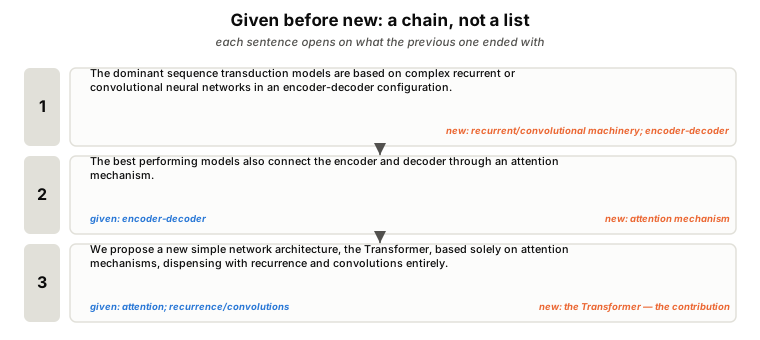
A constructed contrast. Before: “Annotation was performed by three annotators. A Krippendorff’s alpha of 0.78 was obtained. Ambiguous cases were adjudicated by a fourth annotator. Guidelines were revised twice during the process.” Four sentences, four different subjects, no chain; the reader assembles the procedure themselves. After: “Three annotators labelled each instance independently, reaching a Krippendorff’s alpha of 0.78. Cases on which they disagreed were adjudicated by a fourth annotator, whose decisions we used to revise the guidelines twice over the course of annotation.” Each sentence now opens on what the previous one ended with, and the causal relation between disagreement, adjudication, and revision — present in the events but absent from the first version — has become visible without any connective being added.
Common failure modes
The unanchored demonstrative is the single most common cohesion failure in NLP writing: a sentence opening “This shows that…” or “These results suggest…” where “this” and “these” have no recoverable noun, only a preceding paragraph’s general drift. The repair is mechanical — supply the noun (“this gap,” “these three ablations”) — and the failure is worth hunting specifically, because it is invisible to the writer, who knows what the demonstrative refers to. Beyond it: connective mismatch, discussed above; “however” used as punctuation rather than as a claim of contrast; paragraphs that are lists of facts with no topic sentence to make them a claim; and signposting inserted to compensate for an order that should have been fixed instead. A distinct and less obvious failure is over-linking: a paragraph in which every sentence begins with a connective reads as though the argument cannot stand without being told how to hold together, and the connectives that matter lose their prominence — the same flattening III.B described for hedges that appear in every sentence.
A practical check
Read only the first sentence of every paragraph in a section, in order, skipping everything else. They should form a compressed but intelligible summary of that section’s argument. Where they do not — where a first sentence is a fact rather than a claim, or where two consecutive ones do not connect — the paragraph either lacks a topic sentence or is in the wrong place. This check is the section-level counterpart of the sentence-level chain test above, and both are faster than rereading the prose, because both deliberately deprive the writer of the context that hides the failure.