A. Preparing the discourse
From structure to discourse
Part I established what the prototypal article looks like (I.A), how that structure bends under different kinds of claims (I.B), and what function each of its parts serves (I.C). Part II now moves from the whole article to its individual sections, starting with the hypothesis and research question in II.B and proceeding through the Title, Abstract, Introduction, Related Work, Method, and Conclusion. Before any of those sections can be drafted well, however, a preparatory step is needed at a level above any single section: fixing the discourse the article will carry. This section addresses that preparatory step, not yet the writing of any particular part.
The discourse as distinct from the sections
The discourse of an article is its single line of argument — problem, gap, approach, finding, implication — considered independently of which section each piece eventually lands in. It is not the same object as the sequence of sections from I.A: two articles can have an identical macro-structure and yet one reads as a coherent argument while the other reads as a sequence of locally competent but disconnected sections. The difference between them is almost never a structural defect in the sense of I.A — both articles may contain a Title, Abstract, Introduction, Method, Results, and Conclusion in the expected order — but a failure to fix the discourse before distributing it across those sections.
Section I.C’s diagnostic use of the functional taxonomy already pointed at a symptom of this failure: an Introduction and Conclusion that do not visibly correspond, a promise made and a different one kept. That symptom is rarely caused by carelessness in writing either section on its own. It is caused, far more often, by drafting the Introduction and the Conclusion — and everything between them — without first deciding, and holding fixed, what the article’s single line of argument is. Preparing the discourse is the work of deciding that line before any section is drafted, so that each section can be written as an instantiation of it rather than as an independent unit later reconciled with the others.
Decoupling the order of discovery from the order of exposition
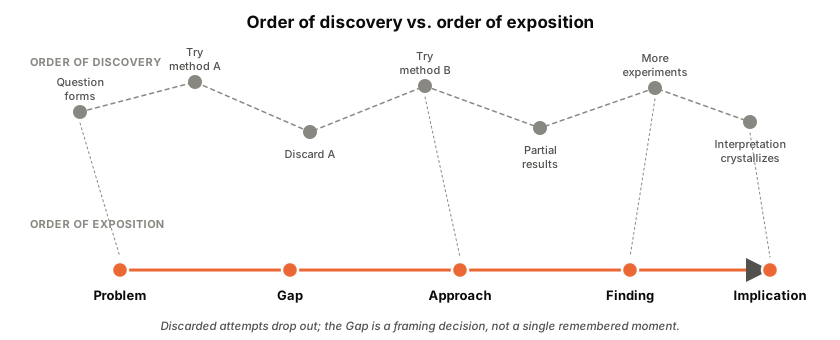
Section I.A noted that the order in which an article presents its content does not match the order in which that content was produced: the Introduction is read first but is rarely written first, and it presents the contribution as a settled conclusion reached before the experiments that, historically, produced it. Preparing the discourse is where this decoupling is made deliberate rather than accidental.
Research proceeds in the order of discovery: a question is refined, methods are tried and discarded, results arrive partially and out of sequence, and the interpretation that finally makes sense of them is often the last thing to crystallize. None of this is the order in which the discourse should be exposed to a reader, whose comprehension depends on encountering the problem before the solution and the claim before the evidence that supports it. Preparing the discourse means choosing the order of exposition as a design decision made in service of the reader, rather than defaulting to the order in which the work happened to unfold — a default that produces articles organized as a narrated lab notebook rather than as an argument.
Practical steps for preparing the discourse
Four steps, taken before drafting any section, operationalize the preparation this section argues for.
- State the central claim in one or two sentences. Before writing any section, write down what the article will claim, in language plain enough to be checked against every subsequent section. This statement is deliberately more informal and less polished than the hypothesis or research question formulated in II.B; its purpose here is only to fix a target that later drafting can be checked against.
- Identify the structural variant the article will follow. Using the distinctions drawn in I.B, decide whether the central claim is best served by a system/method structure, an empirical/analysis structure, a resource/dataset structure, or some other redistribution of the prototype — and note which components this implies will be claim-bearing and need to expand.
- Sort existing material by function before sorting it by section. Take whatever material already exists — results, notes on prior work, method details, known caveats — and sort it using the four-way taxonomy from I.C (access and orientation, claim-bearing core, claim-bounding shell, scholarly apparatus) before assigning any of it to a specific section heading. This step catches material that would otherwise be placed in a section it does not functionally belong in — a caveat drafted into the Introduction because it was fresh in mind while writing, rather than placed in Limitations where its bounding function belongs.
- Draft the discourse as a short, section-free paragraph. Write a single paragraph — problem, gap, approach, finding, implication — with no section headings at all. This paragraph is the discourse in its most compressed form, and every section written afterward should be checked against it: a section that does not visibly serve one of the moves in this paragraph is either unnecessary or has not yet found its place in the argument.
A worked example
Consider how these four steps might have been carried out for the claim behind the HANS diagnostic study (I.B). First, the central claim, stated informally: NLI models that score well on standard benchmarks may be relying on syntactic heuristics rather than genuine entailment reasoning, and a test set engineered to decouple those heuristics from correct labels should reveal this if it is true. Second, the structural variant: this is an empirical/analysis paper, since the claim is a finding about existing model behavior rather than a new model or resource — which flags Results and Analysis, not Method, as the component that will need to expand. Third, sorting existing material by function: prior probing and artifact-detection work goes to the claim-bounding shell (it motivates the gap without being the object of study itself); the models and datasets already available for NLI go to a brief, non-claim-bearing Setup; the constructed heuristic-targeting examples and the resulting accuracy breakdown go to the claim-bearing core. Fourth, the discourse paragraph: “NLI models achieve high accuracy on standard test sets, but it is unclear whether this reflects genuine entailment reasoning or reliance on shallow syntactic heuristics that happen to correlate with correct labels in those test sets. We construct a diagnostic set that decouples these heuristics from correctness, and show that state-of-the-art models’ accuracy collapses on exactly the cases engineered to be misled by them. High benchmark accuracy is therefore not strong evidence that a model reasons about entailment correctly.” Every section of the eventual article can be checked against this one paragraph before any of them is drafted.
A diagnostic for discourse readiness
The four steps above converge on a single test of readiness to begin drafting sections: can the central claim be stated, and briefly justified, without pointing to any specific section of the eventual article? If the claim cannot be stated this way — if answering “what does this article show, and why should it be believed” requires walking through the sections in order — the discourse has not yet been prepared, and drafting prose at this stage risks producing exactly the kind of locally coherent but globally disconnected article this section began by describing. The sections that follow in Part II assume this preparatory work is already done, and address how to instantiate a prepared discourse in each specific part of the article.