D. Keys to a well-structured Introduction
From Abstract to Introduction: the same discourse, expanded
The Abstract, as II.C described it, compresses the discourse into a handful of sentences for a reader who may see nothing else. The Introduction carries the same discourse — the same problem, gap, approach, and preview of the finding — but is addressed to a reader who has committed to continuing into the article, and who can therefore be given room the Abstract did not have: room to be argued into caring about the problem, room for the gap to be motivated rather than merely stated, and room for the approach and contribution to be previewed at a level of detail the Abstract could only gesture at. Nothing new enters the discourse at this point; the Introduction’s job is to expand what the Abstract compressed, not to introduce a different argument.
The four moves of a well-structured Introduction
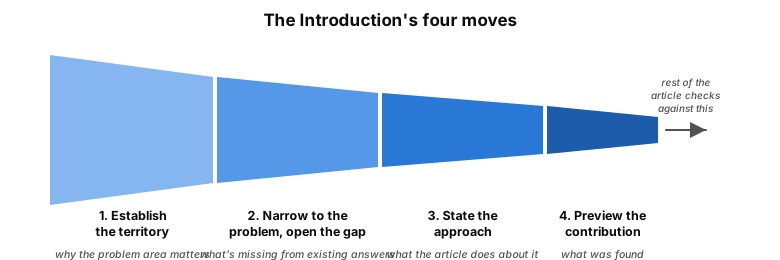
A well-structured Introduction can be read as four moves, each doing a distinct piece of work and each depending on the one before it.
- Establish the territory. Open by stating why the problem area matters, broadly enough that a reader outside the immediate subfield can see the stakes, but already pointed toward the specific problem the article addresses rather than the field in general.
- Narrow to the problem and open the gap. Move from the broad territory to the specific problem the article tackles, and indicate what is currently missing from existing answers to it — the same gap that motivated the research question in II.B. This move only needs to gesture at the gap precisely enough to justify why the question matters now; substantiating it in full, against specific prior work, is Related Work’s job, taken up in II.E.
- State the approach. Introduce, at a level a reader unfamiliar with the technical details can still follow, what the article does to address the gap — the approach half of the discourse paragraph from II.A, given enough specificity to distinguish it from other ways the gap might have been closed.
- Preview the contribution. Close by stating what was found and, in many articles, by an explicit, enumerated list of contributions — the convention noted in I.B for the system/method paper, where this list functions as a table of contents for the claim-bearing components that follow. This move is what the Conclusion will later be checked against, in the same correspondence I.C used as a diagnostic of a prepared discourse.
A worked example
Reconstructing the moves for the claim carried by the HANS study (already used as a worked example in II.A) shows how they build on one another. Move one, territory: progress on natural language inference is usually measured by accuracy on standard benchmarks, and high accuracy is routinely read as evidence that a model performs genuine entailment reasoning. Move two, gap: prior work has raised concerns that such benchmarks contain exploitable artifacts, but it remained unclear whether models were exploiting specific, nameable syntactic heuristics rather than reasoning correctly — existing evaluations did not decouple the two. Move three, approach: this paper constructs a diagnostic test set that isolates three such heuristics from correct entailment labels. Move four, preview: models achieving near state-of-the-art accuracy on standard benchmarks perform far worse on this diagnostic set, exactly where the heuristics and correct labels diverge, indicating that their benchmark accuracy does not reflect the reasoning it is usually taken to reflect. Each move depends on the one before it — the approach in move three only makes sense once the specific gap in move two has been named, and the finding in move four is only interpretable against the claim that move three set up.
Calibrating how much of the gap belongs in the Introduction
The second move is the one most often mishandled, because the temptation is to fully argue the gap where it first appears — surveying prior work, citing extensively, and effectively drafting Related Work a section early. This duplicates work that Related Work’s claim-bounding function (I.C) already exists to do, and it dilutes the Introduction’s claim-bearing focus with content whose job is to situate and bound, not to advance, the argument. The calibration this section recommends is economy: the Introduction should name the gap in a sentence or two, with at most a citation or two as evidence that the gap is real, and defer the fuller argument — why existing approaches fall short, in what specific ways, against which specific prior work — to Related Work. A reader should finish the Introduction believing the gap exists without yet having been walked through the literature that establishes it.
The contribution list, and its alternatives
The enumerated contribution list is the most visible convention of the fourth move, but it is not universal, and Section I.B already showed why: it fits the system/method paper well, since a list of technical contributions maps directly onto the claim-bearing components that will substantiate each one, but it fits the other two variants less naturally. The empirical/analysis paper more often closes its Introduction with a stated research question and a one-sentence preview of the answer, since there is no list of technical contributions to enumerate — the contribution is the finding itself. The resource/dataset paper more often closes by naming what is being released and at what scale, since the “contribution” is the resource rather than a set of technical design choices. In every variant, though, the function is the same: the closing move must give the reader something specific enough to check the rest of the article, and eventually the Conclusion, against.
Common failure modes
An Introduction that never narrows — that stays at the level of broad motivation without ever stating the specific problem or gap — leaves a reader unable to tell, by the end of it, what the article is actually going to do; this is the first move repeated without progressing to the second. An Introduction that front-loads a full literature review duplicates Related Work and buries the article’s own contribution under material whose bounding function belongs elsewhere. An Introduction that states the approach before the reader has been given a reason to want it — moving to the third move before the second has done its work — reads as a solution in search of a problem. And an Introduction whose closing preview does not match what the Conclusion, or the Abstract, ultimately states is the same correspondence failure raised in II.C and I.C, now appearing at the component where it is most consequential, since the Introduction is what sets the expectation every other component is subsequently measured against.
A practical check
Because the Introduction’s four moves are sequential and cumulative, a useful check after drafting is to label each paragraph with the single move it serves. A paragraph that does not clearly serve one of the four — that is not establishing the territory, narrowing to the gap, stating the approach, or previewing the contribution — is either misplaced material that belongs in Related Work, Method, or Limitations, or it is not yet earning its place in the article at all.