H. Other parts
Why these parts share a heading
Sections II.B through II.G worked through the components whose drafting requires shaping the article’s central argument: the hypothesis, the Title and Abstract, the Introduction, Related Work, Method and Experiments, and Conclusion and Discussion. Four components from I.A’s eleven remain without a dedicated section of their own — Results and Analysis, Limitations, the Ethics statement, and the scholarly apparatus of Acknowledgments, References, and Appendix — not because I.C found them functionally unimportant, but because writing them well is a narrower, more procedural problem than the argument-shaping decisions the earlier sections addressed. This section takes each in turn.
Results and Analysis: separating reporting from interpretation
Section I.C described this component’s evidentiary function as two distinct acts folded into one section: reporting what happened, which is answerable to the data, and interpreting what it means, which is answerable to the argument. Writing it well means keeping that distinction visible on the page rather than letting a finding and its interpretation blend into a single unexamined sentence — a reader should be able to tell which sentences are reporting a number and which are arguing about what that number implies. How the section is organized follows directly from the structural variant chosen back in II.A: the system/method paper typically centers on a single main results table followed by a shorter ablation, as I.B described, while the empirical/analysis paper typically organizes around the sub-questions or themes identified when the hypothesis was outlined in II.B, interpreting each in turn rather than deferring all interpretation to the end. In either case, the numbers reported here are what the Experiments section in II.F fixed a protocol for; the variance and significance-testing commitments made there should be honored and reported here, not silently dropped once the numbers turn out favorably.
Limitations: deriving scope, not collecting caveats
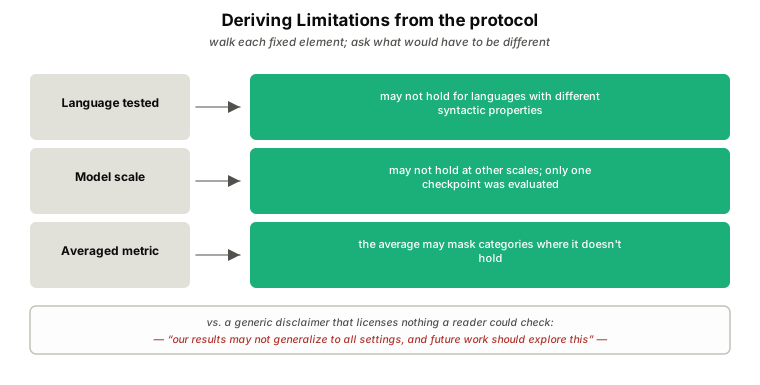
Section I.C’s diagnostic for a failing Limitations section was specific: one that reads as a list of unrelated caveats has typically been assembled after the fact, rather than derived from what the central claim actually licenses. The practical alternative is to derive Limitations systematically from the protocol fixed in II.F, rather than to brainstorm caveats independently of it: walk through each element that was fixed there — the data, the baselines, the metrics, the implementation — and ask, for each, what would have to be different for the finding not to hold. A finding tied to one language, one model scale, or one annotation scheme yields a limitation stated in exactly those terms, rather than a generic disclaimer that could have been attached to any article in the field. This derivation is also what keeps Limitations distinct from the forward-looking third move of the Conclusion (II.G): Limitations states the conditions under which the present claim holds, while that closing move of the Conclusion points to new questions the claim raises, and the two should not be used to restate each other.
A worked example. Suppose the Experiments section fixed a protocol using one language, one model scale (a single pretrained checkpoint), and a metric that averages performance across a benchmark’s categories. Walking through each element yields three specific limitations, not one generic disclaimer: the finding may not hold for languages with different syntactic properties than the one tested, since nothing in the protocol tested cross-lingual transfer; the finding may not hold at other model scales, since only one checkpoint was evaluated and the mechanism behind the result was not isolated from scale-specific effects; and the averaged metric may mask categories where the finding does not hold, since a per-category breakdown was not the protocol’s focus. Contrast this with a generic Limitations paragraph that instead states “our results may not generalize to all settings, and future work should explore this further” — a sentence that is true of every article ever written and licenses nothing a reader could check.
Ethics statement: specific to the work, not generic
The Ethics statement extends the same bounding function from the scope of the scientific claim to its foreseeable use and misuse, as I.C put it, and the most common way this component fails is by being written generically — a boilerplate paragraph about responsible NLP research that could be attached to any article in the field without alteration. Writing it well means grounding it in what is actually foreseeable given this specific contribution: what could this particular method, finding, or resource be used for beyond its stated purpose, and what risk does that use carry. The stakes are highest for the resource/dataset paper, where I.B’s worked example already noted that a current article would be expected to address the demographic composition of its annotators, their compensation, and the licensing status of its source material — considerations with no equivalent burden in a system paper whose Ethics statement is more often a brief note on compute cost or dual use.
A worked example. A generic Ethics statement for a text-generation system might read: “As with all NLP systems, our model could be misused to generate harmful content. We encourage responsible use.” This is true of nearly every generation system and tells a reader nothing about the specific article. A specific version, grounded in the actual contribution, might instead name the particular capability introduced — for instance, that the method improves fluency in low-resource languages — and note the foreseeable risk that follows from that particular capability, such as its use to generate more convincing misinformation in languages where detection tools are less mature than for high-resource languages, and what if anything the release (model access, documentation, usage terms) does to mitigate that specific risk. The difference between the two versions is exactly the difference between an Ethics statement that could be copy-pasted onto any article and one that could only have been written for this one.
Scholarly apparatus: References, Appendix, Acknowledgments
The three components I.C grouped as apparatus need less argumentative craft than any other part of the article, but each still has a standard of its own. References must be complete and accurate enough to support the traceability function I.C assigned to it — every factual claim about prior work made in Related Work (II.E) should be checkable against an entry here, and every entry should correspond to a claim actually made rather than to a citation added for the appearance of thoroughness. The Appendix should reflect the routing decisions already made while drafting the Method and Experiments (II.F): material sent there for being configuration detail rather than core design should be organized and cross-referenced clearly enough that a reader following a pointer from the main text can find it without searching. Acknowledgments, finally, carries no argumentative weight at all and needs none — a brief, accurate note of funding and assistance is the whole of its job, and effort spent polishing its prose is effort better spent elsewhere in the article.