D. Precision and consistency in terminology
A term is a pointer, and the article owns the referent
The assumption III.C ended on can be stated as a responsibility. A technical term in a scientific article is a pointer to a construct, and fixing what it points to is the article’s job, not the reader’s. A reader encountering an undefined or unstable term has three options — infer the referent from context, import a referent from elsewhere in the literature, or read on without one — and all three transfer work from the writer to the reader, with the last two capable of producing a reader who has understood something other than what was written. This is not a matter of pedantry: the whole apparatus of III.B, matching a sentence’s modality to the strength of its evidence, presupposes that the reader and the writer are making claims about the same thing.
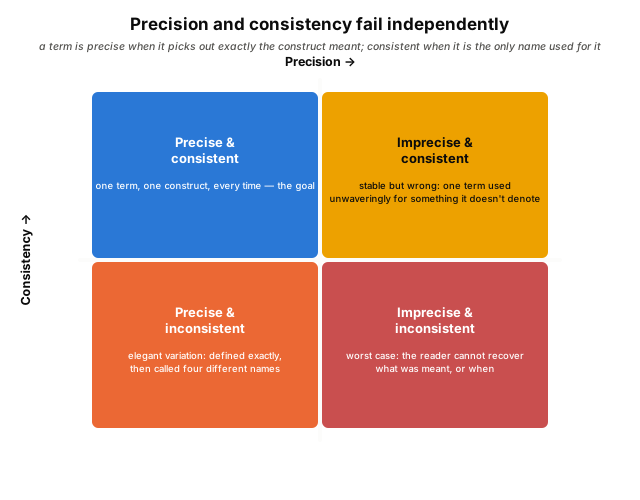
Two requirements follow, and they fail independently. Precision is the requirement that a term pick out exactly the construct meant, no wider and no narrower. Consistency is the requirement that the same term be used for that construct every time it appears, and used for nothing else. An article can be precise and inconsistent — defining a construct exactly, then referring to it by four different names — or consistent and imprecise, using one term unwaveringly for something it does not quite denote. The first failure is more common and easier to fix; the second is more damaging and harder to notice.
Elegant variation, and why prose habits work against consistency
Most writers arrive at scientific writing with a habit acquired from every other kind of prose: vary your word choice, because repeating a noun four times in a paragraph reads as clumsy. That habit is correct in literary and journalistic prose, where the reader is not tracking a technical referent, and it is actively harmful here. A paragraph that refers to the same object as “our model,” “the network,” “the system,” and “the proposed architecture” forces every reader to decide whether these are one thing or four — and only readers who already know the answer will decide correctly. The cost falls on exactly the reader II.C said the Abstract exists to serve, the one without the surrounding context. Repetition of a defined term is not a stylistic weakness in this genre; it is the mechanism by which the reader is kept anchored, and a writer’s discomfort with it is a habit to be overridden rather than a signal to be followed.
Terminology and construct validity
Section II.F asked whether the metric fixed in the Experiments section actually operationalizes the construct the hypothesis in II.B is about, or merely something correlated with it. Section III.D is that same question asked at the level of the word. A term that drifts between a construct and its operationalization — using “accuracy” in one sentence and “reasoning ability” in the next to refer to the same measured quantity — quietly performs the substitution that II.F warned against, but does it in the vocabulary rather than in the protocol, where it is much harder to see. This is also, precisely, how the capability-overclaiming of III.B enters an article whose modality is otherwise disciplined: a writer who would never assert “we have shown that the model reasons” may nonetheless write “reasoning performance” as a column header, and the claim arrives intact through the noun phrase.
Borrowed vocabulary and its unpaid entailments
NLP has borrowed a substantial part of its vocabulary from linguistics, psychology, and ordinary speech, and the borrowed terms arrive carrying entailments that the technical usage does not license. “Attention” names a specific weighted-sum operation and simultaneously invokes a selective-focus faculty. “Understanding,” “reasoning,” and “knowledge” name behavioral regularities on benchmarks and simultaneously invoke mental states. “Hallucination” names ungrounded generation and simultaneously invokes a perceptual pathology. “Emergent” names a discontinuity in a performance curve and simultaneously invokes an irreducibility that the measurement does not establish.
The point is not that these terms should be avoided — several are now so entrenched that avoiding them costs more clarity than it buys, and the Transformer’s own name for its central operation is one of them. The point is that the connotation does argumentative work whether or not the writer intends it, and that the writer is answerable for it. Two disciplines are available: use the behavioral term where one exists (“accuracy on the entailment task” rather than “entailment reasoning”), or keep the loaded term and define it explicitly at first use, stating what is and is not being claimed by it. What is not available is using the loaded term undefined and disclaiming its connotation later in Limitations, which is the II.C correspondence failure appearing once more, now at the level of a single noun.
Introducing, defining, and naming
Section II.C established that the Abstract cannot use an acronym or a piece of terminology it has not itself introduced, because for most of its readers no other context will be read. That constraint generalizes: a term is defined at its first claim-bearing use, wherever that occurs, and the definition should be the kind a reader can check a later usage against rather than a gesture toward one. Notation in the Method follows the same rule, with the added burden that symbols are harder to look up than words — a reader who has forgotten what a subscript denotes has no way to search for it.
Naming a new artifact is the same problem in its most consequential form. Section II.C noted the colon-title pattern common to resource papers, where a citable name precedes a description; SQuAD and HANS are both instances, and both names are doing work beyond decoration. A name that will be used by other authors for years must be short enough to say, distinctive enough to search for, and expanded on first use in every component that must stand alone. A name that merely compresses a phrase into initials without being memorable or searchable imposes a lookup cost on every future reader without supplying the benefit a name exists to supply.
Matching to the structural variant
The three variants from I.B distribute the terminological burden differently. The resource/dataset paper carries the heaviest naming burden, since its contribution is the named artifact and every subsequent citation depends on that name being stable and findable. The empirical/analysis paper depends most on precision in naming phenomena, since I.B noted its results are typically broken down by category or linguistic phenomenon rather than aggregated — and a breakdown is only interpretable if each category label denotes something the reader can hold fixed. The system/method paper depends most on consistency between components: a module named in the Method must appear under that same name in the ablation table, or the table cannot be read against the architecture it is ablating.
A worked example
The HANS study (I.B) is a clean instance of terminological discipline in the empirical variant. The paper names three heuristics — the lexical overlap heuristic, the subsequence heuristic, and the constituent heuristic — and states them in exactly those terms in the abstract, uses them to organize the construction of the evaluation set, and reports results broken down by the same three names. A reader looking at the results breakdown does not have to work out which category corresponds to which claimed mechanism, because the naming never varies. Notice also what the three names are not: they are behavioral descriptions of a decision rule, not attributions of a mental state, which is what allows the paper’s headline claim to stay at the modality III.B credited it with.
A constructed contrast makes the failure visible. An article introduces “syntactic diversity” in its Introduction, measures a corpus statistic it calls “structural variety” in its Experiments, reports a column headed “diversity” in its Results, and concludes that “grammatical richness” improves performance. Four names, and no statement anywhere that they denote one thing. A reader cannot tell whether the conclusion restates the measurement or generalizes past it — and neither, in most cases, can the author, which is the deeper cost of the failure.
Common failure modes
Elegant variation, discussed above, is the most frequent. A term used at two granularities — “model” meaning sometimes the architecture and sometimes a specific trained checkpoint — is the most frequent precision failure, and is especially damaging in a Limitations section derived per II.H, where the scope of a claim depends on which granularity was tested. Acronym proliferation imposes a memory cost that grows faster than the number of acronyms, since a reader must hold all of them simultaneously to read a table. A term can be silently redefined mid-article, usually when a section is drafted much later than the one that first introduced the term. And a term can appear in the Title or Abstract and never be defined anywhere, which is II.C’s self-containment requirement failing at the one component where it matters most.
A practical check
Build a terminology inventory before the final revision pass: list every technical term the article uses in a claim-bearing sentence, note the single location where each is defined, and then search the draft for plausible synonyms of each one. Every synonym found is either a consistency failure to be repaired or a second construct that needs a name and a definition of its own. The inventory is also the cheapest place to catch the borrowed-vocabulary problem above, since a loaded term with no definition line next to it is exactly what the list makes visible.