C. The Title and Abstract
Writing the components that must stand alone
Section I.C classified the Title and Abstract together, under access and orientation, precisely because they are read by every reader who encounters the article, including the large majority who read no further. That functional classification has a direct consequence for how they must be drafted, which this section addresses: unlike every other component, the Title and Abstract cannot rely on context established elsewhere in the article, because for most of their readers no other context will ever be read. In practice this rules out forward references (“as shown below”), citations that assume the reader already has the surrounding literature in mind, and any acronym or piece of terminology that has not been introduced within the Title or Abstract itself. A Title or Abstract that is only accurate once the rest of the article has supplied missing context has failed at the one job these two components have that no other component shares.
The Abstract as the discourse, compressed
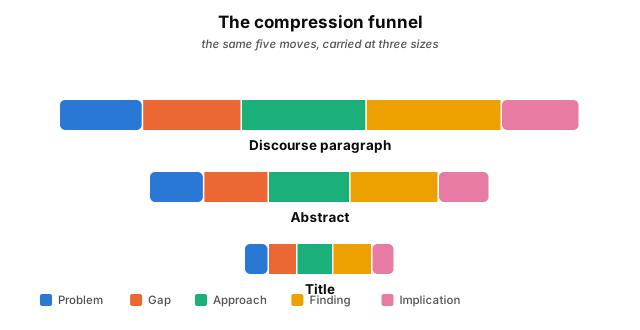
The fourth step of II.A asked for the discourse to be drafted as a short, section-free paragraph — problem, gap, approach, finding, implication — before any section was written. The Abstract is that same paragraph, addressed now to a reader who may see nothing else, and typically expanded to somewhere between roughly one hundred and two hundred and fifty words, depending on venue. The moves are the same five as the discourse paragraph, and most well-formed abstracts can be read as one to two sentences per move: a sentence of motivation, naming why the problem matters; a sentence naming the gap that the research question from II.B addresses; a sentence or two describing the approach at a level a non-specialist in the subfield could follow; a sentence stating the finding, with a specific, checkable number or comparison rather than a vague assertion of improvement; and, where relevant, a closing sentence on implication or on what is being released.
Two consequences follow from treating the Abstract as a compression of the discourse rather than as a separate piece of writing. First, an Abstract that is difficult to write is usually a sign that the discourse itself was never cleanly fixed in II.A, not a sign that the Abstract needs more polishing in isolation — the fix in that case is to return to the discourse paragraph, not to keep rewriting the Abstract’s sentences. Second, the Abstract should be checkable, sentence by sentence, against the hypothesis or research question from II.B and against the Conclusion once it is drafted; an Abstract whose finding sentence does not match the Conclusion’s is the same correspondence failure I.C diagnosed for the Introduction and Conclusion, appearing one component earlier.
The Title as the Abstract, compressed further
The Title compresses the Abstract’s central claim into a single line, and is best drafted after the Abstract, once that claim is fixed, rather than before. Two patterns recur across the worked examples already used in I.B. The first is the declarative or evocative title that states the contribution without naming the technical method in full — “Attention Is All You Need” does not contain the word “Transformer,” the name later given to the architecture it introduces, and trades a fully descriptive title for one that is short and memorable. The second is the colon title, which itself splits into two distinct uses: a hook followed by a precise technical scope, as in “Right for the Wrong Reasons: Diagnosing Syntactic Heuristics in Natural Language Inference,” where the phrase before the colon draws attention and the phrase after it states exactly what is being diagnosed; and a name followed by a description, as in “SQuAD: 100,000+ Questions for Machine Comprehension of Text,” the pattern most common in resource papers (I.B), where the resource needs a citable name in addition to a description of its content and scale.
Whichever pattern is used, the same access-and-orientation function from I.C governs the choice: a title should let a reader searching or browsing correctly predict whether the article is relevant to them, which favors including the field’s actual terms for the problem and approach over cleverness that would only be legible to someone who has already read the Abstract.
Matching Title and Abstract to the structural variant
Section I.B’s three structural variants shape the Title and Abstract as directly as they shape the rest of the article. The system/method paper typically names or gestures at the method and states the headline comparative result in the Abstract’s finding sentence, since that comparison is the article’s central claim. The empirical/analysis paper typically states the question or the assumption under test in the Title itself and gives the finding as an answer to that question in the Abstract, rather than as a performance number, since there is no artifact to report a number about. The resource/dataset paper typically names the resource in the Title, colon-style, and devotes the Abstract’s approach and finding sentences to what was collected, at what scale, and what quality it was verified to have, since adequacy rather than performance is the claim being made.
Common failure modes
Three failures recur regardless of structural variant. An Abstract can read as an introduction in miniature — citing prior work, hedging claims that have not yet been supported by anything the reader has seen, or assuming background the reader does not yet have — when its function calls for a self-contained summary instead. An Abstract can spend most of its word budget on motivation and never state the finding in checkable terms, leaving a reader unable to tell, from the Abstract alone, what was actually shown. And a Title or Abstract can claim more, or less, than the Conclusion ultimately supports — a mismatch in scope between the two ends of the article that is a specific instance of the overclaiming failure taken up in Part III, and one of the easiest to catch simply by rereading the Title and Abstract immediately after finishing the Conclusion.