G. Conclusion and Discussion
The closing function, and where Discussion fits within it
Section I.C assigned the Conclusion a closing function: it introduces no new evidence, and instead ties the Results back to the promise made in the Introduction, stating what that promise turned out to license and what remains open. “Discussion” does not appear as its own numbered item in I.A’s eleven components — its function, stepping back from individual findings to state what they jointly establish, is one that I.B already located inside Results and Analysis for the empirical/analysis paper, where a Discussion or Implications subsection closes that component by drawing out what the individual sub-findings establish together. The same function can instead be folded into the Conclusion itself, or given its own section between Results and Conclusion, and which placement is used varies by venue and by how much interpretive work the findings require. What does not vary is the distinction this section maintains regardless of placement: Discussion interprets and broadens what was found; Conclusion closes the argument opened in the Introduction. Housing both under one heading, as this section’s title does, should not be read as license to blur that distinction on the page.
The moves of a well-written Conclusion
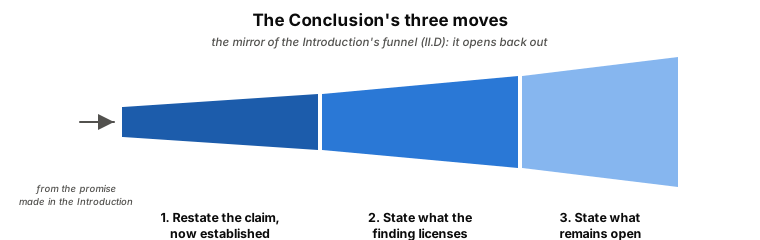
Symmetrically with the four moves that opened the Introduction in II.D, the Conclusion can be read as three moves that close it.
- Restate the central claim, now as an established result. Return to the claim previewed in the Introduction and the hypothesis fixed in II.B, and state plainly whether, and to what extent, the evidence in Results supported it. This is a restatement, not a new argument — its content should already be fully supported by what came before.
- State what the finding licenses. Go one step beyond restatement to say what the finding means for the problem established in the Introduction: what can now be done, claimed, or assumed that could not be before. This is the one place in the Conclusion where the article is permitted a small amount of generalization beyond the literal result — but only as much generalization as the evidence in Results actually supports.
- State what remains open. Name the natural next questions the finding raises, distinct from what was promised and not delivered. This forward-looking gesture is easy to confuse with Limitations, but the two serve different functions in I.C’s taxonomy: Limitations bounds the claim by stating the conditions under which it does or does not hold, a claim-bounding move, while this closing move points to genuinely new questions the present finding opens up, a claim-bearing move that extends the discourse rather than constraining it.
A worked example
The Transformer paper’s Conclusion (I.B) instantiates these three moves compactly. Move one, restated claim: the paper presented the Transformer, the first sequence transduction model based entirely on attention, dispensing with the recurrence and convolutions used in prior encoder-decoder architectures. Move two, what the finding licenses: on the translation tasks reported in Results, the model trains substantially faster than architectures based on recurrent or convolutional layers, while reaching a new state of the art — licensing the claim that attention alone is sufficient for this class of problem, not merely a viable supplement to recurrence. Move three, what remains open: the Conclusion looks ahead to extending attention-based models to problems beyond text, to modalities such as images and audio, and to generation that is less strictly sequential than the decoding used here — questions the paper’s own results do not address, offered as a direction rather than as a finding. Notice that move three names problems the reported experiments were never run on, which is exactly what keeps it a claim-bearing extension of the discourse rather than a Limitations-style qualification of the claim already made.
Common failure modes
A Conclusion can violate its own closing function by introducing a new result or a new comparison not shown in Results — evidence appearing for the first time in a component whose job is to close the argument, not extend it. A Conclusion can also fail simply by adding nothing: restating the Abstract’s language almost verbatim, without the specific claim of move one — that the evidence did or did not support the hypothesis — actually being stated, leaves a reader unable to tell what, if anything, is now settled that was only promised at the start. Most consequentially, and most often flagged throughout this course, a Conclusion can fail to correspond to the Introduction: promising one contribution at the start and closing a different one at the end, the mismatch I.C used as a diagnostic of an unprepared discourse (II.A) and that II.C and II.D each returned to for the Abstract and Introduction in turn.
Where Discussion is given its own space, whether as a subsection of Results and Analysis or as a section of its own, its most common failure is overclaiming: drawing a causal or universal conclusion from evidence that only supports a narrower, correlational, or single-dataset finding — the same overclaiming failure I.B flagged for the empirical/analysis paper specifically, and one taken up more generally in Part III. A second common failure is duplication: a Discussion that re-argues material that belongs in Limitations (the conditions under which the finding holds) or in Related Work (how the finding relates to prior claims), rather than confining itself to what the findings, taken together, newly establish.
Matching Conclusion and Discussion to the structural variant
The three structural variants from I.B continue to shape this pair of components. In the system/method paper, the Conclusion is typically short, restating the contributions listed in the Introduction (II.D) against what the ablation study in Experiments actually established, with little separate Discussion, since the central claim is a comparative performance result that needs restating more than interpreting. In the empirical/analysis paper, Discussion typically carries substantial weight of its own, since the value of this variant lies precisely in what a set of individual findings establishes when read together, and the Conclusion that follows can then be brief, since the interpretive work has already been done. In the resource/dataset paper, the Conclusion typically closes with a statement of intended use and what is being released — the same closing move already anticipated in the Abstract’s optional implication sentence (II.C) — rather than a restated performance claim, since the contribution being closed is the resource’s adequacy, not a comparative result.
A practical check
The correspondence check invoked throughout this course can now be made concrete: place the Introduction’s closing move — its contribution list or stated preview (II.D) — next to the Conclusion’s first move, item by item, and confirm that each promised item is explicitly closed, neither silently dropped nor quietly replaced by a different claim. Any promised item without a corresponding closed item marks either an argument that was never finished or an Introduction that was never revised to match the article the rest of the sections actually became.