F. Common lexical pitfalls: redundancy, verbosity, weasel words
A catalogue, and why this section is shaped differently
Sections III.A through III.E each concerned a positive choice — a register to adopt, a modality to match, a voice to select, a term to fix, an order to impose — and each was argued in prose because the choice required a rationale. This section is different in kind: it catalogues recurring local failures, most of which need identification and a repair rather than an argument. A catalogue is properly a lookup structure, and this section is therefore built around a table, which no other section of the course uses. The prose that follows establishes what the four categories have in common; the table is the part meant to be returned to while revising.
What they have in common is a single accounting. Every one of these pitfalls costs the reader something specific — attention, page space, or the ability to check a claim — and returns nothing. That is what distinguishes them from the genuinely difficult trade-offs treated earlier, where a choice served one function at the expense of another.
Redundancy, and the repetition that is not redundant
One distinction has to be made first, because the obvious rule is wrong. Parts I and II established that the same discourse appears at several granularities by design: the Abstract compresses it (II.C), the Introduction expands it (II.D), the Conclusion closes it (II.G), and each of these is a legitimate re-presentation of the same argument to a reader in a different position. Repetition across components is structural and required. The failure is repetition that does not change granularity — a Conclusion that restates the Abstract’s sentences at the same level of detail, which II.G already flagged as adding nothing, or a paragraph that makes a point and then makes it again in different words.
At sentence level the same test applies. “In order to be able to evaluate” contains three ways of saying one thing; “past history,” “future plans,” and “the end result” each carry a modifier already entailed by the noun. None of these is a stylistic infelicity to be tolerated in a hurry — each occupies space in a document with a hard page limit, and space in an article is genuinely scarce.
Verbosity, and the buried verb
Section III.A raised nominalization and passed it to III.C as a question of voice; III.C then established that it is not one, since rewriting a nominalized sentence in the active voice with the same buried verb repairs nothing. What remains to be said is what the problem actually is. In “the performance of an evaluation of the model was undertaken,” the action of the sentence is evaluate, and it has been converted into a noun, leaving the verb slot to be filled by a semantically empty one — undertake, perform, conduct, carry out. The reader must then reconstruct the action from the noun before the sentence can be understood at all. The repair is to restore the action to the verb: “we evaluated the model.” Voice is orthogonal to this; the passive “the model was evaluated” is equally repaired, and III.C’s account of which to choose still applies afterwards.
Three further constructions inflate length without adding content. Expletive openings (“there is,” “it is the case that,” “what we observe is that”) postpone the subject and the verb, so the reader waits several words before learning what the sentence is about. Stacked prepositional phrases (“the evaluation of the performance of the model on the subset of the data”) chain modifiers where a compound or a possessive would do. And throat-clearing openers (“It is important to note that,” “It should be emphasized that”) assert importance rather than demonstrating it — a magnitude claim of the kind III.A said casual register makes uncheckably, arriving in a formal costume.
The cost is concrete rather than aesthetic. Major NLP venues impose hard page limits, so words spent on these constructions are words unavailable for the differentiation sentence II.E requires for each cluster of prior work, or the specific, protocol-derived limitations II.H asked for in place of a generic disclaimer. Verbosity is not merely a tax on the reader; it is a reallocation of space away from the components that carry the argument.
Weasel words, and how they differ from hedges
This is the category most easily confused with the material of III.B, and the distinction is the section’s most important. A hedge marks the epistemic strength of a claim and is informative: “suggests” tells the reader that what follows is an interpretation not uniquely determined by the evidence, and a reader who trusts the writer’s calibration learns something from it. A weasel word simulates that marking while carrying no information: “it is widely believed that,” “some researchers argue,” “certain issues have been raised,” “recent work has shown” with no citation attached. The construction looks like an epistemic qualification and is in fact an evasion, since no reader can determine who believes it, how widely, or on what basis.
The test is directly checkable and worth stating as a rule: does the qualifier let a reader recover what was claimed and at what strength, or does it only make the sentence harder to disagree with? A hedge survives the test; a weasel word fails it. Applied to III.B’s four strengths, the difference is that a hedge places a claim at one of them and a weasel word places it at none.
Uncited attributions deserve a separate note. “Recent work has shown” without a citation is not only a weasel construction but an attribution problem — it borrows the authority of a literature without identifying it, and prevents the reader from checking whether the literature says what is claimed. This connects to the citation practices taken up under ethical writing in Part V.
Intensifiers, and the special case of “significantly”
Intensifiers — “very,” “extremely,” “clearly,” “obviously,” “dramatically” — assert a magnitude that the sentence does not supply and the reader cannot check, which is III.A’s argument against casual register reappearing inside otherwise formal prose. “Clearly” and “obviously” carry an additional cost: they characterize a reader who fails to find the point obvious, which is not a productive stance to take toward a reviewer.
“Significantly” deserves separate treatment because it is two words. In one register it names the outcome of a statistical test; in the other it means “by a large amount.” Using it without a test both inflates the sentence and violates III.D’s precision requirement, since the term points at two constructs and the reader cannot tell which is meant — and in a Results section, where the reader has every reason to expect the statistical sense, the ambiguity is at its most damaging. The discipline is to reserve “significantly” for the tested sense, report the test, and use a plain magnitude word or the number itself otherwise.
The table
| Pitfall | Example | Repair | What it costs the reader |
|---|---|---|---|
| Same-granularity repetition | A Conclusion restating the Abstract sentence for sentence | Change the granularity or cut the component back to its three moves (II.G) | Page space, and the signal that nothing was settled between the two ends of the article |
| Tautological modifier | “past history,” “the end result,” “future work to be done later” | Delete the modifier | Attention spent parsing a word that adds nothing |
| Buried verb (nominalization) | “the performance of an evaluation of the model was undertaken” | Restore the action to the verb: “we evaluated the model” | Reconstruction of the action before the sentence can be read |
| Expletive opening | “There is a tendency for accuracy to drop” | “Accuracy tends to drop” | Several words before the subject arrives |
| Stacked prepositions | “the evaluation of the performance of the model on the subset” | “model performance on the subset” | Working memory held open across four nested phrases |
| Throat-clearing | “It is important to note that accuracy drops” | “Accuracy drops” | An unsupported importance claim in place of the point |
| Unattributed attribution | “Recent work has shown that…” | Cite the work, or state it as this article’s claim at its own strength | The ability to check the claim; also a citation-practice issue (Part V) |
| Anonymous consensus | “It is widely believed that,” “some researchers argue” | Name who, cite them, or drop the framing | Any way to determine whose view this is or how held |
| Vacuous qualifier | “certain issues,” “various factors,” “a number of settings” | State which issues, which factors, how many settings | The specificity that would make the sentence checkable |
| Intensifier | “very strong results,” “dramatically better” | The number, or a magnitude the Results support | A magnitude claim with no evidence attached |
| “Clearly” / “obviously” | “Clearly, the model fails on long inputs” | Delete, or state why it follows | Nothing gained; a reader who disagrees is characterized rather than persuaded |
| Untested “significantly” | “significantly outperforms” with no test reported | Report the test, or say “outperforms by 3.2 points” | Ambiguity between the statistical and colloquial senses (III.D) |
Matching to the structural variant
Little varies here, since these failures are structural-variant-independent, but the exposure differs. The system/method paper is most exposed to intensifiers and untested “significantly,” since its central claim is comparative and the temptation to characterize a margin rather than report it is strongest there. The empirical/analysis paper is most exposed to weasel constructions, since its claims sit at III.B’s strengths 2 and 3 more often, and the line between a hedge and an evasion is correspondingly easier to cross. The resource/dataset paper is most exposed to verbosity, because its procedural sections are long, descriptive, and rarely reread by the authors with the same attention the argumentative components receive.
A worked example
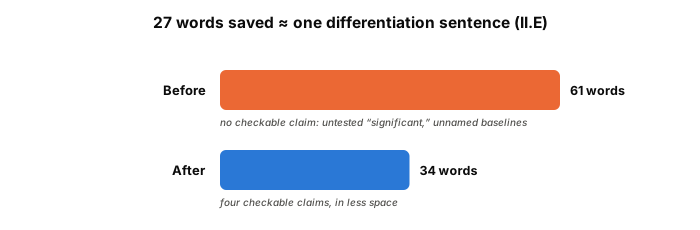
Before (61 words): “It is important to note that there is a significant improvement in the performance of our model in comparison with a number of various baseline systems. It is widely believed that this kind of approach is very effective, and recent work has shown that certain issues with previous methods can clearly be addressed through the utilization of this technique.”
After (34 words): “Our model outperforms the three baselines in Table 2 by 3.1 to 4.6 F1 (p < 0.01, paired bootstrap). Gururangan et al. (2018) attribute the failure of previous methods on this task to annotation artifacts, which our filtering step removes.”
The rewrite is not merely shorter. The first version contains no checkable claim at all: “significant” is untested, “a number of various baseline systems” names none, “it is widely believed” attributes to no one, “certain issues” specifies nothing, and “clearly” asserts what the sentence has not shown. The second version makes four checkable claims in less space, and the twenty-seven words saved are roughly the length of one differentiation sentence (II.E) — which is the accounting this section opened with, made concrete.
A practical check
Two passes, both mechanical. First, the subtractive pass: for each qualifier, intensifier, and adverb in a claim-bearing sentence, delete it and ask whether the claim changed. If nothing changed, it was occupying space; if the claim became too strong, what was deleted was a hedge doing real work under III.B’s rule and should be restored. This single test separates hedges from weasel words faster than any amount of rereading. Second, the string audit: search the draft for “significantly,” “clearly,” “obviously,” “very,” “it is important to note,” “it is widely believed,” “recent work has shown,” “in order to,” “there is,” and “there are,” and inspect every hit. Not all are errors — “significantly” with a reported test is correct, “there is” is occasionally the natural construction — but the hit rate is high enough that the search is worth the minute it takes.