E. Ethical writing: citation practices, attribution, and the Limitations section
A citation is a checkable claim
Section I.C described References as standing to Related Work as a ledger stands to the argument built on it: Related Work asserts what prior work established, and References is what lets a reader check the assertion. That relation is what makes citation an epistemic practice rather than a bureaucratic one, and it means III.B’s rule governs claims about other people’s work exactly as it governs claims about one’s own. Writing that a prior article showed something it in fact suggested is a modality error with someone else’s evidence, and it is not made harmless by the citation being present and correctly formatted.
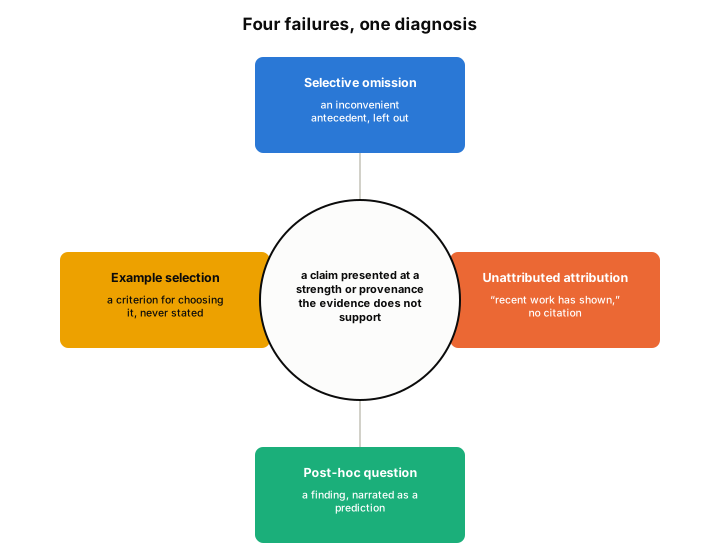
This section collects four failures deferred here from earlier parts. They look like different problems — an omission, a phrasing, a narrative device, an example — and they are the same failure in four positions: a claim presented at a strength or provenance the evidence does not support.
Selective omission
Section II.E flagged Related Work that omits prior work inconvenient for the novelty claim, calling it not merely a stylistic weakness but an integrity issue and deferring it here. Under this section’s framing the diagnosis is sharper. A Related Work section makes an implicit claim — that the work it surveys is the relevant prior art — and omitting a close antecedent falsifies that claim while leaving every individual sentence true. It is the one citation failure that cannot be detected by checking any sentence in the article, only by knowing the literature.
It is also self-defeating in a specific way that III.B already described in another context: the readers most likely to notice are the ones who know the work best, which at a reviewed venue means the reviewers, since papers are assigned to reviewers by topical match. The omission is therefore most visible to precisely the readers who decide the article’s fate, and the honest alternative is cheaper than it appears — II.E’s differentiation sentence, which states the axis on which the present work differs, converts a threatening antecedent into evidence that the authors know the space.
The unattributed attribution
Section III.F flagged “Recent work has shown that…” twice, in its prose and in its table, as a construction that borrows the authority of a literature without identifying it, and noted that the reader loses any ability to check the claim. As a citation-practice matter the point extends. The construction is not only unhelpful; it is a claim about the state of the literature, made at strength 1, with no evidence offered — and it is frequently made by writers who have not verified it, precisely because the construction does not require them to. The repair III.F gave stands: cite the work, or state the proposition as this article’s own claim at its own strength. The choice between those two is itself informative, since a writer who cannot find the citation has learned something about whether recent work has in fact shown it.
Plagiarism, including the cases that are not obvious
Verbatim reuse of another author’s text without quotation is the clear case and needs no elaboration. Three adjacent cases are less clear and more common. Dual submission — the same work under review at two venues simultaneously — is prohibited by essentially every venue in the field and is a matter of process rather than text. Reuse of one’s own prior text is genuinely ambiguous in the case of shared method descriptions across a research programme, and the operative question is whether a reader would be misled about what is new; venue policies differ and should be read rather than assumed. Paraphrasing another article’s Related Work rather than the work it summarizes is the case most rarely named and most frequently committed: a writer who characterizes a paper on the basis of how a third paper characterized it is asserting something they have not checked, and inherits any error in the intermediate summary. This is a citation failure and a reliability failure at once, and it is undetectable in the text — which is exactly why the practical check below is the one it requires.
The post-hoc question presented as a prediction
Section IV.B deferred the narrated discovery that conceals a post-hoc question — “we were surprised to find,” where the finding came first and the question was constructed afterwards to frame it. Why this belongs under ethics rather than under narrative is worth stating precisely. A research question stated before the results were seen and a research question constructed after them have different evidential status: the first was at risk of being answered negatively, the second was not. Presenting the second as the first misrepresents how much the evidence constrains the conclusion, which is III.B’s modality rule violated at the scale of the whole article rather than of a sentence.
The remedy is not to suppress exploratory findings, which would be a considerable loss. It is to mark them: a finding arrived at exploratorily, stated as exploratory and accompanied by a statement of what a confirmatory test would look like, is a legitimate and often valuable contribution. What is not legitimate is the retrospective narrative that converts it into a prediction that was borne out.
Example selection
Section IV.D deferred the qualitative example whose selection criterion is never stated. The ethical dimension is the same misrepresentation in miniature: an example presented without a criterion invites the reader to treat it as representative, and if it was chosen because it was favourable, the invitation is false. The discipline IV.D named — randomly drawn from a stated pool, or chosen to illustrate a named category identified in the analysis — costs one clause and converts an anecdote into evidence of a specified kind. The same applies to the failure cases an article chooses to display, where the temptation runs the other way and a suspiciously mild failure example is as misleading as a suspiciously strong success.
Limitations as an obligation, not a component
Section II.H asked that Limitations be derived from the protocol rather than collected as caveats, and I.C placed it among the claim-bounding components. Two facts recorded in V.C change its status. It is mandatory at ARR venues, must be titled “Limitations,” and its absence is grounds for desk rejection; and it does not count toward the page limit. Together these make it the one component in the article where honesty has been made structurally cheap — there is no space cost, and there is a process cost to omitting it.
That removes the usual defences and leaves only one real question, which is II.H’s: whether the section states the conditions under which the finding does and does not hold, or whether it lists generic caveats that would fit any article. Section IV.E argued that Limitations is what makes an ambitious framing survivable, and the ethical version of that argument is stronger: a claim whose boundaries are stated can be relied on within them, and a claim whose boundaries are not stated will be relied on outside them by someone, which is a foreseeable consequence of publishing it.
Matching to the structural variant
The three variants from I.B are exposed at different points. The system/method paper is most exposed on selective omission, since its contribution is defined as an increment over prior art and the incentive to narrow the surveyed prior art is structural. The empirical/analysis paper is most exposed on the post-hoc question, because analysis work is genuinely exploratory in the ordinary course of research and the boundary between an exploratory finding and a predicted one is crossed by a change of tense. The resource/dataset paper is most exposed on example selection and on the artifact obligations V.D described, since its examples are its most persuasive content and its licensing and consent claims are ones no reader can verify from the article.
A worked example
A single sentence, at three provenances. “Recent work has shown that domain match is the primary determinant of fine-tuning effectiveness.” As written this is III.F’s unattributed attribution: unverifiable, and asserted at strength 1. “Gururangan et al., ‘Don’t Stop Pretraining: Adapt Language Models to Domains and Tasks’ (ACL 2020), found that a second phase of in-domain pretraining improves downstream performance across four domains and eight classification tasks.” This is checkable, scoped to what was measured, and attributed — and it is also visibly narrower than the first version, since a gain from in-domain pretraining is not a finding that domain match is the primary determinant of anything, and certainly not a comparison against syntactic diversity. “Domain match is widely assumed to be the primary determinant of fine-tuning effectiveness; we are aware of no direct comparison against syntactic diversity.” This is the article’s own claim about the state of the literature, stated as such, and it is honest in a way the first version was not — it says what the authors know and how they know it, and it converts an unsupported assertion into the gap that IV.A’s framing needs.
The third version is also the one most likely to survive review, because a reviewer who knows of such a comparison will name it, which is a better outcome than the first version’s failure mode, where a reviewer who knows the literature concludes the authors do not.
Common failure modes
The uncited attribution and the selective omission, discussed above, are the two most common. Beyond them: the citation that supports a stronger claim than the cited work makes, which is a modality error committed with someone else’s evidence and is the most frequent citation failure that survives review; the citation inherited from another paper’s summary without the source being read; the Limitations section written from a template rather than derived from the protocol, which II.H already treated and which the page-limit exclusion now leaves without excuse; and the exploratory finding retrospectively narrated as a prediction, which is the one failure in this section that the article’s own authors are best placed to detect and least motivated to.
A practical check
Take every sentence in the article that makes a claim about someone else’s work, open the cited article, and locate the sentence that supports it. Two failure kinds surface immediately: claims whose support cannot be found, and claims stated at a strength the source does not reach. This is III.B’s modality audit applied outward rather than inward, it is the only reliable defence against the inherited-summary failure above, and it is slow — which is the reason it is worth naming as a distinct pass rather than assuming it happens during drafting.