A. Formal academic register vs. casual writing
Register, tone, and voice are three different things
These three terms are routinely used interchangeably and are worth separating before any of them can be discussed usefully. Register is the systematic level of formality of a piece of writing: its vocabulary, its sentence complexity, its use or avoidance of contractions, idiom, and colloquialism. Tone is the writer’s stance toward the material — confident, exploratory, cautious, dismissive — and is the subject of III.B, where stance is treated as a claim about the strength of one’s own evidence. Voice, in the grammatical sense taken up in III.C, is the narrower question of whether a sentence is built around an agent or around what was acted upon. A piece of writing can be formal in register and dismissive in tone; it can be confident in tone and heavily passive in voice. Treating the three as one variable is what produces the unhelpful advice that scientific writing should simply be “more formal,” which conflates a fix for one problem with a fix for all three.
Why register is functional rather than traditional
The reason to write in a formal academic register is not that informality is disrespectful or that the field expects it. It is that casual register carries emphasis a reader cannot check. Intensifiers (“dramatically better,” “hugely important”), idiomatic shortcuts (“our model blows the baselines away”), and rhetorical asides all assert a magnitude or a significance without supplying the evidence that would let a reader assess it — and they do so in a way that is difficult to argue with, because nothing precise enough to contest has actually been said. Formal register, by contrast, forces magnitude to be stated in terms the Results section can be checked against. Seen this way, register is continuous with the falsifiability that II.F assigned to the Experiments section: it keeps claims in a form that can be verified rather than merely felt.
This account also explains where register may legitimately loosen. The Title’s job (II.C) is access and orientation, not argument, and a hook of the kind used in “Right for the Wrong Reasons” trades a degree of formality for memorability without asserting anything a reader would need to check. Acknowledgments, which I.C singled out as the one component carrying no argumentative weight at all, is under no register constraint deriving from evaluation, since there is no claim there to evaluate. The constraint is strongest exactly where the argument is.
Register varies by component
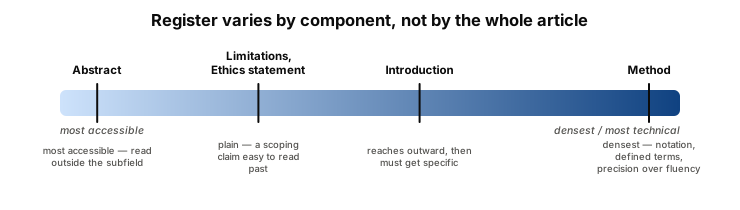
It follows that a single register does not fit the whole article, and that the appropriate register for each component is derivable from the function I.C assigned it. The Method’s function is reconstructive, and a dense technical register — notation, defined terms, precise but unlovely noun phrases — serves that function well, since a reader of the Method has committed to the article and needs precision more than fluency. The Abstract’s function is access and orientation, and it is read by people outside the subfield deciding whether to continue; it therefore requires the most accessible register in the article, and technical density there is a functional failure rather than a mark of rigor. The Introduction sits between the two, since its first move (II.D) must reach a reader outside the immediate subfield while its fourth must be specific enough to be checked. Limitations and the Ethics statement are plainer still, because a scoping statement written in dense register is easy to read past, which defeats the purpose of stating it.
Matching register to the structural variant
The three variants from I.B distribute register differently, in ways I.B’s tone paragraphs already anticipated. The system/method paper is comparative throughout: its register is built around measurable relations between systems, and its Method carries the highest technical density in the article. The empirical/analysis paper is more narrative, since I.B noted its prose must connect each sub-finding back to the motivating question; its register is accordingly closer to expository argument than to specification. The resource/dataset paper shifts register most visibly within itself, moving from the procedural register of Data Collection — where the goal is reproducibility of process, and the writing reads almost as documentation — to the stewardship register of the Ethics statement and Limitations, where “we release,” “we recommend,” and “users of this resource should” belong to a different mode of address entirely.
A worked example
Consider one claim written at three registers. Casual: “Our model absolutely crushes the previous state of the art on translation, and it trains way faster too.” Overformal: “It may be observed that the proposed architecture demonstrates a not insubstantial performance differential with respect to the extant state of the art, in conjunction with a reduction in requisite training duration.” Appropriate: “Our model achieves 28.4 BLEU on the WMT 2014 English-to-German translation task, improving over the existing best results, including ensembles, by over 2 BLEU” — the actual sentence from the Transformer paper’s abstract. The first version asserts a magnitude the reader cannot check; the third states one that can be checked against a table. The second, notably, is no more checkable than the first: it has traded contractions and idiom for nominalization and hedging without adding a single verifiable quantity, which is the point of the next failure mode below.
The register shift within the same article is equally instructive. The Transformer paper’s abstract is written for a reader deciding whether to continue, in ordinary prose with one number per claim; its Model Architecture section, twenty column-inches later, is written in defined notation, with dimensions and head counts stated as symbols. Neither register would work in the other’s place, and the difference between them is not an inconsistency but a correct response to two different functions.
Common failure modes
Register can shift mid-article for no functional reason — a Results section that drifts into conversational asides, or an Introduction that opens in notation — which signals to a reader that the components were drafted at different times and never reconciled, the same symptom of an unprepared discourse that II.A diagnosed structurally. Formality can be mistaken for nominalization and abstraction: “an evaluation of the applicability of the method was performed” is more formal than “we evaluated the method” only in the sense of being longer, and it is worse at its job, a point III.C takes up as a question of voice. And register can become dense enough to obscure: a sentence a specialist must read twice has failed regardless of how precise its vocabulary is, because precision that is not received is not precision.