Skip to main content
Link
Menu
Expand
(external link)
Document
Search
Copy
Copied
Writing Scientific Articles
Home
Introduction
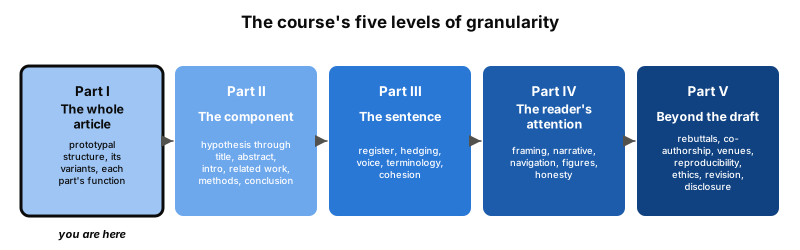
Part I. Traditional Structures of Scientific Articles
A. Overview of the prototypal article in Natural Language Processing
B. Three specific examples of common structure
C. The different roles of the different parts of an article
Part II. The Parts of the Article
A. Preparing the discourse
B. Outlining the hypothesis and research question
C. The Title and Abstract
D. Keys to a well-structured Introduction
E. Locating the article within Related Work, and differentiating efficiently
F. Methods and experimental protocol writing
G. Conclusion and Discussion
H. Other parts
Part III. Tone of the Discourse and Lexical Choices
A. Formal academic register vs. casual writing
B. Hedging and epistemic stance: avoiding overclaiming and underselling
C. Active vs. passive voice, and when each serves the argument
D. Precision and consistency in terminology
E. Cohesion and transitions between sentences and paragraphs
F. Common lexical pitfalls: redundancy, verbosity, weasel words
Part IV. Engaging the Reader
A. Framing the contribution: why the reader should care
B. Narrative structure: what storytelling transfers, and what it does not
C. Guiding the reader: signposting, questions, and the nonlinear read
D. Figures and visualizations as engagement tools
E. Balancing rigor and excitement without overselling
Part V. Advanced Topics in Scientific Article Writing
A. Writing rebuttals and responding to reviewers
B. Collaborative writing and the seams it leaves
C. Adapting an article to different venues
D. Reproducibility statements and supplementary material
E. Ethical writing: citation practices, attribution, and the Limitations section
F. From draft to camera-ready: revision and editing strategies
G. Writing assistance and disclosure
Conclusion
Search Writing Scientific Articles
Part I. Traditional Structures of Scientific Articles
Table of contents
A. Overview of the prototypal article in Natural Language Processing
B. Three specific examples of common structure
C. The different roles of the different parts of an article